
10 minute read
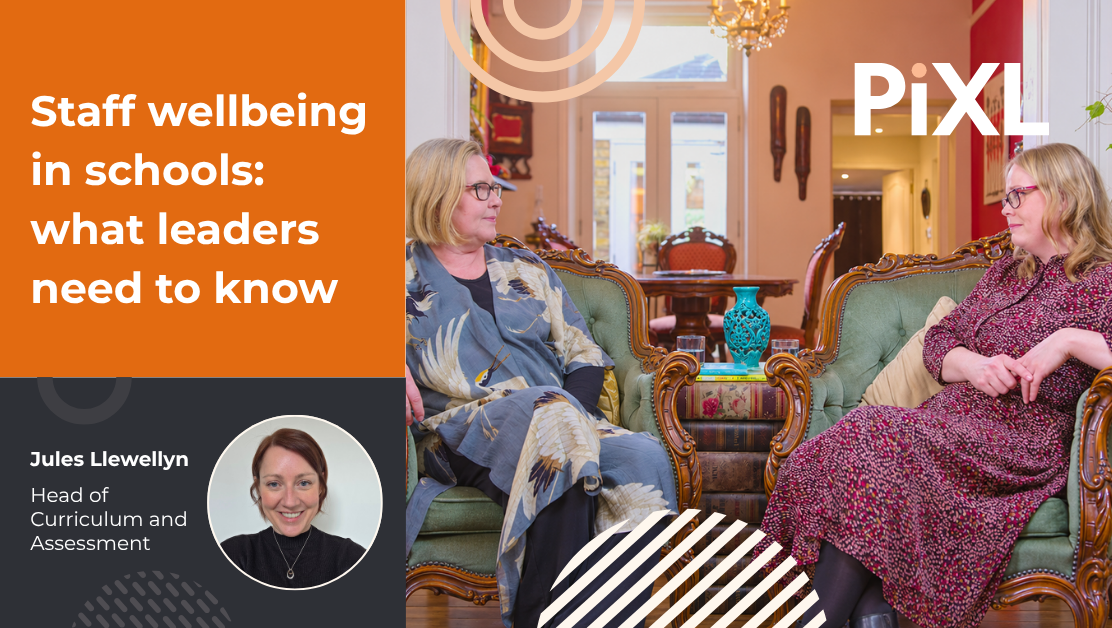
Staff wellbeing is on every school’s agenda, but it is often misunderstood. When PiXL CEO Rachel Johnson sat down with Dr Emma Kell, their conversation went a long way past the cake in the staff room. Emma is a teacher, leader and coach with 27 years in UK secondary schools, a doctorate on teacher wellbeing and parenting, and books including How to Survive in Teaching.
Most of Emma’s career has been positive. Two years were not. She had chosen a school that didn’t fit her values and tried to prove herself by working 70 or 80 hours a week, often going from Monday to Thursday without seeing her two young children.
“When you’re not enacting your values, it makes you ill,” she says. By the end, she had stopped talking. Her husband would ask about her day, and she had nothing to say.
If you lead a school, some of this may sound familiar. You may notice it in yourself, or in a colleague who has lost their spark. Emma’s point is that it doesn’t have to be this way, and that leaders are well placed to change it. Here is what she told us about what wellbeing really is, what it isn’t, and how you might apply it in your own school.
What wellbeing isn’t
Wellbeing is not the cake in the staff room. It is not the compulsory yoga session after school on a Friday, either. Emma has seen exactly that, and the response from many staff was predictable: “I want to go home.”
It’s the right sentiment with the wrong output. The school decides what will make people feel better, then asks them to give up personal time they could have used to recharge in their own way. Wellbeing is also not asking “How are you, really?” and following it with a request for a document that was due last Tuesday. And it isn’t about being happy all the time, or leaders pretending everything is fine, so no one worries.
So, what is it? For Emma, it comes down to self-efficacy. “No one goes into teaching for an easy life,” she says. “The best form of wellbeing is going home on a Friday feeling tired but knowing you’ve made a difference.”
For leaders, the test is simple: does this initiative add to staff’s load, or take something off it?
People pleasing and the wellbeing paradox
Many people come into teaching to make a difference. Emma argues that this is also where the trouble can start.
Making a difference feels good, so we do more of it. And there is always more to do: a thousand students, a hundred staff, endless injustices to put right. We keep giving time and energy until the thing that once brought us joy no longer does.
It’s a trap people pleasers fall into easily, and Emma calls it “the wellbeing paradox”. To break the cycle, she turns to organisational psychologist Adam Grant’s idea of “otherish giving”:
- Selfless givers say yes before the question is finished. Extra cover, the canteen duty, the Saturday event: “I’m flexible, I’m indispensable.”
- Otherish givers are just as generous, but they give with a purpose in mind. This course will help my students. This favour helps a colleague I trust. Crucially, they can say no.
Otherish givers have boundaries. If your hand goes up before the question in briefing has been finished, you may recognise the selfless giver in yourself. As a leader, look out for it in your team too. Notice who always volunteers, and share the load, so your most generous colleagues don’t burn out on your behalf.
Saying no without guilt, at every level
Emma knows what it is to be a middle leader with too much to do and no obvious way to say no. There’s pressure from above and pressure from your team, and when you’re exhausted, your ability to prioritise and stand up for yourself is the first thing to go.
Her first piece of advice to middle leaders is to be honest. People can tell when you’re pretending, and a leader who shows their department how they navigate a hard week gives them permission to be human too.
Her second is to deal in facts, not feelings. Instead of “I’m drowning,” she suggests something like this:
“I can see this is important. Here’s what’s already on my plate. What would you like me to take off it so I can do this?”
Two words do a lot of the work here:
- Capacity. “I don’t have the capacity for this at the moment” is calm and hard to argue with.
- Reasonable. “It would be reasonable for me to deliver this in three weeks” moves the conversation on to what can be done.
For senior leaders, the question is what happens when that conversation lands on your desk. If a middle leader brings you their plate, the most useful response is to help them decide what comes off it. When your team knows it’s safe to say no to you, they are far more likely to tell you when they’re struggling.
That starts with your own example. Emma notes that many heads feel they must look fine all the time, so no one worries about them. Being honest about your own capacity shows your team that saying no is allowed at every level.
Rachel adds another technique: “no, because”. “I’m saying no to you because I’m saying yes to my children.” Naming what the yes protects makes the no easier to say, and easier to hear.
Leading wellbeing by example to prevent burnout
Whether you’re the caretaker, a trainee teacher or the CEO, someone in your building wants to be like you. If it isn’t one of the adults, it will be one of the students.
Emma shares three lessons she took from conversations with Dr Karen Edge about her Global City Leaders research into young school leaders. They are simple enough to test tomorrow:
- How fast do you walk? Unless you’re training for a marathon or teaching PE, slow down. Rushing down a corridor tells everyone, and your own body, that there’s an emergency when there isn’t one.
- How many bags do you carry? Every Friday, someone watches a colleague load a suitcase of marking into their car and concludes that weekends are for work. Most of those bags come back on Monday unopened.
- Are your basic needs being met? The burned-out leaders weren’t using the toilet at work, because they weren’t eating or drinking. They had lost sight of what they needed, let alone how to get it.
None of this is deliberate. When leaders are focused on getting the job done, they rarely stop to think how their own habits look to everyone else: the rushed walk, the bags of marking, the skipped lunch. If you can’t yet change them for your own sake, Emma suggests changing them for the people who love you and the people who work with you. They are watching more closely than you think.
Making time to think
We are in the business of teaching people how to think, yet teachers rarely get time to do it. Even protected time like PPA can disappear into a cup of tea, a string of interruptions and the bell. The best ideas tend to arrive when we step away: the psychologist Graham Wallas called this incubation, the stage that lets illumination happen. Emma’s coach has her own name for it: “staring at the wall time”.
Schools can create it. Encourage a 20-minute walk at lunchtime. Open a quiet room, or even the sensory room, to staff having a hard day. And when leaders spend time off site, it gives them space to think and shows their team they’re trusted. One deputy told her head: “You tell me I’m brilliant, but you never leave me on my own to get on with it.”
Meetings are the other obvious place to start. Rachel runs leadership meetings at PiXL to a few clear rules:
- Everyone knows beforehand whether the meeting is for discussion, decision or exploration.
- Papers are read and feedback is given in advance, so time together goes on what’s contested.
- Big decisions get a cooling off period of a few days, giving ideas time to settle rather than being made on the spot.
- Meetings finish on time. Every minute over builds resentment, especially for anyone with a childcare pickup.
For senior leaders, protecting thinking time starts with your own diary.
Why good enough protects well being
Perfectionism is one of the quickest routes to exhaustion, and Emma believes many teachers have perfectionist tendencies. Praise doesn’t help: “well done” just becomes proof that the task must have been easy. That is why she argues for “good enough”, which many people hear as lowering standards.
Emma learned this early. In her twenties, she taught languages with puppets, costumes and a buzzer, and her whole department worked the same way. The students loved the lessons, but the team had been so busy entertaining that no one had checked the exam specification, and results suffered. All that effort had gone into the wrong things.
For leaders, this is a wellbeing decision as much as a teaching one. If the lessons that get noticed and praised are all singing, all dancing ones, staff will keep working late to produce them. Making it clear that reliable, decent teaching is the standard gives people permission to stop. Headteacher, Helena Marsh, refers to this as the “daily diet”, if it is consistently good, the results will be excellent.
Why wellbeing is not selfish
Wellbeing isn’t a bolt on, Emma says. It’s the professional learning, the communication, the meetings, the marking policy and the relationships in a school. Getting that right is a moral imperative and a practical one.
What gives Emma hope is a room full of new teachers. Whether they’re 22 or 52, they have chosen teaching despite the headlines. What makes her angry is watching people like them burned out by practices that could be changed.
“If we want to make a difference, we have to be well,” Emma says. “It is not a selfish act. If we’re worn-out husks, what message are we sending, as role models to young people? ”
For leaders, the question is less about what your school offers for wellbeing and more about what its everyday habits say to staff. Start small: end the next meeting on time, leave the bags at school on Friday, and make it safe for your team to say no. Your staff will notice, and they will follow. And it isn’t yours alone to carry. As Emma puts it, every adult in a school has more control than they think.
PiXL members, watch the full conversation here.
Not a PiXL member? Find out more.