Forty Seconds at Primrose Hill: Part 4 of 4. The leader’s view.
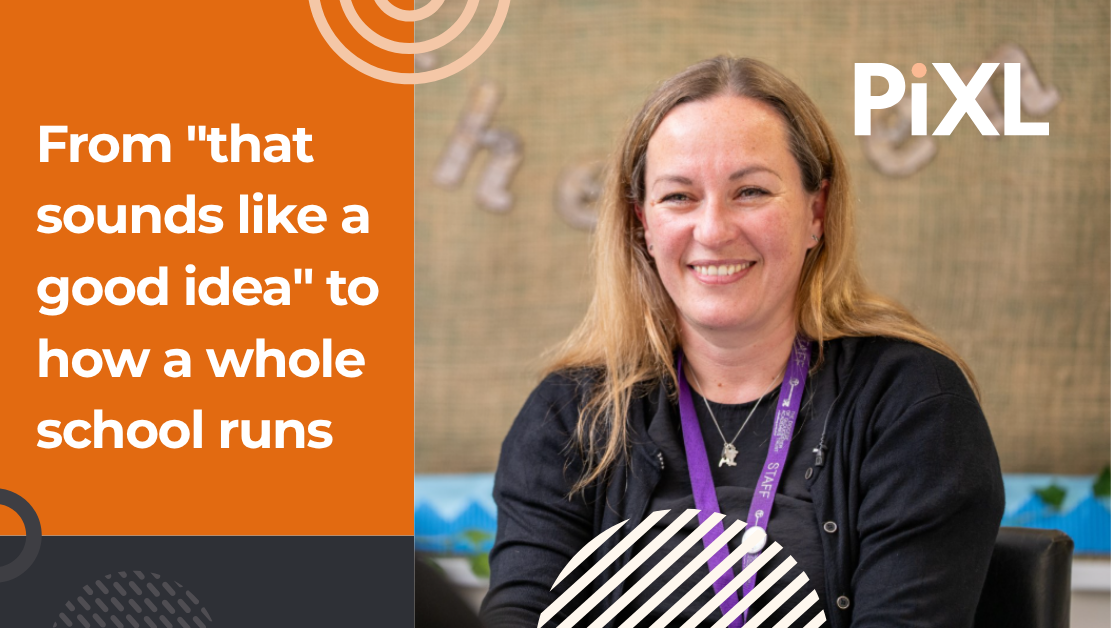
Emma Mignaud has been head teacher at Primrose Hill Church of England Primary Academy since 2019. By her own admission, she already had a good school before any of this, with a positive previous inspection and a settled, supportive community. So, the question worth putting to a leader in that position is why she would change anything at all. Her answer explains how an idea from a hospital ended up running through a primary school in the Forest of Dean.
She first heard the word compassionomics at a Trust heads day, where Rachel Johnson from PiXL was speaking. The research, drawn from medicine, found that a 40-second compassionate conversation could measurably lower a patient’s anxiety. The same studies linked it to shorter hospital stays and to less pain after an operation. Emma’s reaction was immediate, and it tells you something about how she leads. “I thought, if it can do all of that for patients, it can have a huge impact with some of our children.”
Maximum impact, lowest effort
Emma’s direct about her own philosophy. “Maximum impact for lowest effort. Those are the things that tend to gain the most traction when you’re introducing them.” Compassionomics fitted exactly. It cost a teacher almost nothing to do, and the potential return was out of all proportion to that.
She knew the first objection would be time, so she met that head on. She opened the staff meeting after that heads day with a question. “Has anyone got a spare 40 seconds?” Of course they did. Only then did she explain what those seconds were for, and she connected it to the school’s reason for doing anything. “We always come back to the why,” she said. Emma is clear that it sharpened the relationship-building the school already believed in and gave it a tighter focus.
That targeting is the heart of it. Primrose Hill builds good relationships with every child, but Emma identified a group at risk of slipping through warmth that’s spread evenly across a room. “Some children are perhaps a little bit invisible in their day. They’re very well behaved, they’re compliant, but they don’t put themselves out there.” The strategy is a deliberate conversation, held every day, with those children, the ones who would never demand one. Everyone in the school, teachers, teaching assistants and the office staff, has one or two targeted children they make a beeline for. The teaching assistants, Emma notes, have become the biggest drivers of it, and have grown in confidence by seeing the difference they make.
The stone in the pond
Emma has an image for how it spreads. “Compassionomics is the stone that falls into the pond.” The targeted conversations are the stone, deliberate and daily. The ripple is everything that follows: adults having warm conversations with children who aren’t on anyone’s list, simply because the school has got better at it. The sharpest results show up in the targeted children, and the wider culture lifts with them.
The case studies she shared show both. One child in Year 4 was completing none of his home reading or times-tables practice. A teaching assistant held a daily 40-second conversation with him, generic at first, then gently focused, with a line that did the real work: “When I get home tonight I’m going to check the app to see you’ve been on it.” The child knew an adult was thinking about him after the school gates closed. Five minutes a day became a habit, the habit built, and he ended up standing in worship to collect a certificate for recalling every multiplication and division fact faster than any adult in the school. The knock-on reached his maths. A child who hadn’t been at age-related expectations was, a year later, working at greater depth. “Success breeds success,” Emma said, and she attributes the start of it to a conversation that cost under a minute.
Another of Emma’s targeted children was a boy who found friendships hard and could struggle to regulate his emotions. She took this one on herself and her way in was rocks. He was, in her words, a little obsessed with them, so the daily 40 seconds was mostly about rocks, to the point that he bought her a rock advent calendar at Christmas and she now calls herself an expert. The change showed at playtime. He’s no longer on the edge of things. He has a crowd around him, building rock houses and telling them about what he has found on the playground. Behaviour incidents dropped, his attendance improved, and Emma puts it down to those few seconds a day.
She’s just as deliberate about parents, and just as careful. One mother was disengaged and kept her son at arm’s length from school. Emma didn’t march toward her, knowing a head walking straight at you can feel like a summons. Instead, she positioned herself near the gate, sometimes pretending to pick up a piece of litter, then stood and walked in alongside her with an easy, generic chat. On the days they didn’t speak, Emma sent a warm message home about something good her son had done. The mother started smiling before she saw her. The boy’s attendance went from 80 per cent to 97 per cent. “She felt that she belonged to the community of our school,” Emma said, “and that was really powerful, for her and for us.”
How you measure 40 seconds
Asked how a leader measures something this small, Emma names both halves. There’s hard data, the attendance figures, the assessment scores and the targeted children climbing. And there’s soft data which she values just as much. “The children who are smiling, the feeling you get when you walk around. If I’m off site for a couple of days, the children come straight up to me when I’m back. They feel like they’ve missed me.” For Emma the belonging runs both ways: “It’s not just that they belong here. They belong, and I belong as well.”
What PiXL gave her
Emma is exact about what PiXL gave her, and it’s worth spelling out, because it‘s easy to assume the wrong thing. The network did the background reading for her. “They do the donkey work,” she said, condensing research she would never have had time to wade through, including work like compassionomics that comes from outside education altogether. That last part matters to her. Education, she says, can become insular, and some of the best ideas come from looking beyond it. Alongside the research, PiXL gave her specialists she can book a surgery with for niche problems, and a group of other leaders who have walked the walk and aren’t her bosses, which counts for a lot in a role she describes as isolating. The approach itself she kept in her own hands. “It’s not ‘you must do it like this,’” she said. “It’s ‘this is an idea, fit it to your school.’” It worked because it was moulded to Primrose Hill, by the people who know Primrose Hill.
Her advice to a head sitting on the fence about any of it is the plainest thing she said. “Do it. You will get some of your life back. You’ll give yourself permission to slow down and think strategically about your school.”
When asked to sum it up in a sentence, after a year of watching it work, she said: “Compassionomics is low effort and has maximum impact.”
It started as an idea from a hospital, passed on at a heads day. A year later it’s simply how Primrose Hill works, and the head who introduced it will tell you it cost almost nothing.
This completes the four-part Forty Seconds series. Primrose Hill C of E Primary Academy is a PiXL member school in the Forest of Dean. They first heard about compassionomics through PiXL.
Further reading
Trzeciak, S. and Mazzarelli, A. (2019) Compassionomics: The Revolutionary Scientific Evidence That Caring Makes a Difference. Studer Group Publishing.