

Tag: school leadership

  • Small choices, big connection: how we best communicate as leaders 

    Small choices, big connection: how we best communicate as leaders 

    5 minute read

    I have been reading Adam Grant’s new book, Vibe, and one idea has stayed with me all week. Connection is not built in grand gestures. It is built in the small choices we make how we speak to people, how we read them and how we respond when things get hard. 

    As leaders, we communicate all day long. Emails, briefings, corridor conversations, the message at 9pm that we tell ourselves can’t wait until morning. Every one of those moments either builds connection or wears it down. There is no neutral. 

    Grant busts three myths that every school leader needs to hear.  

    • You don’t need to be alike to connect.  
    • Chemistry can be slow.  
    • Closeness can be quick. 

    In other words, the relationships we think are fixed rarely are. So here are five habits I keep coming back to that I find helpful to remind myself about.

    Use your voice 

    We reach for email because it feels safer, yet research by Amit Kumar and Nicholas Epley found that people feel more connected when they hear someone’s voice than when they read their words, and calls are no more awkward than text, whatever we might predict. Text carries information but a voice carries the person and the tone. 

    I am not suggesting we abolish email. But sometimes the thank you, the worry you need to express, or the difficult conversation deserve your voice. A voice note can carry warmth when a call feels like too much. When the news is hard, a phone call lets your tone do the work that text sometimes can’t do.

    Check your story 

    Chris Argyris and Peter Senge’s Ladder of Inference is one of the most useful tools I know. It explains how we can see something small, add meaning, make assumptions, reach a conclusion and act on it, often in seconds. Sometimes we have jumped to quite the wrong conclusion and then, worse, act on it. 

    Perhaps an employee leaves your meeting without a word. By the time they reach the car park, you have decided they don’t back the plan and aren’t a team player. In reality, they had just taken a call about their poorly child. We didn’t stop to get curious; we just ran up the inference ladder and made things worse. 

    The danger is that our beliefs then decide what we notice next time. So before you act, ask yourself one question: what did I actually see or hear? 

    See the best 

    Sandra Murray’s 1996 studies turned traditional relationship advice on its head. Her research found that the happiest couples see each other more generously than their friends do. They link flaws to strengths: he’s stubborn, but that’s why he never gives up. In other words, they see their partner’s flaws but re-frame them. 

    This isn’t just for romantic relationships though. The best teams do this too. The colleague who is over-detailed is the reason nothing slips. The one who is blunt is the one who tells you the truth. Being generous does not mean we are blind, or deluded, we still need to name the behaviours that need to change. But when we hold a high opinion of someone, their flaws stop looming so large. In turn, we see them positively even in their weaknesses. People can feel it when we do this. 

    Welcome the feeling 

    Developmental psychologist Dr Aliza Pressman has a phrase I love: all feelings are welcome, all behaviours are not. She wrote it for parents, but it is for leadership too. 

    People will feel frustrated by a restructure, anxious before an inspection, hurt by a decision. Those feelings are allowed. It is what we do with them that matters. 

    The words we choose make all the difference. “What’s wrong with you?” shuts people down. “I understand why that affected you so much” opens them up. Research from Ohio State shows validation protects people’s mood, while invalidation escalates emotion. Validating isn’t agreeing. It is simply saying: you make sense. When people feel we understand, or are trying to, we can better problem-solve together. 

    Be consistent 

    This one stopped me in my tracks because it isn’t what I have always believed. Julianne Holt-Lunstad found that our blood pressure rises more around people we feel mixed about than around people we simply dislike. With difficult people, we know what we are getting. With mixed people, we stay on alert, because we don’t. 

    Think about what that means for leadership. Some leaders sound like a Craig David song: warm on Monday, cutting on Thursday, enthusiastic on a Friday. This inconsistency is more exhausting for your team than being steady and demanding. Consistency is a form of kindness. Do your staff know which version of you will turn up? If they don’t, they will be wasting precious energy on trying to work it out. 

    Our challenge this week 

    Use your voice. Check your story. See the best. Welcome the feeling. Be consistent. 

    None of these cost money.  All of them take intention. So here is my challenge: pick one this week. Just one. Swap one email for a call. Pause before you climb the ladder. Name the strength in the colleague who frustrates you. 

    Then take it to your next senior team meeting and ask everyone to pick one too. Culture is not what we write in our vision statements. It is what people feel when they walk away from a conversation with us. 

    Stronger leaders, stronger schools. It starts with how we speak to each other. 

    PiXL members, for more practical leadership tools, join our Stronger Leaders Programme 

    Not a PiXL member? Find out more
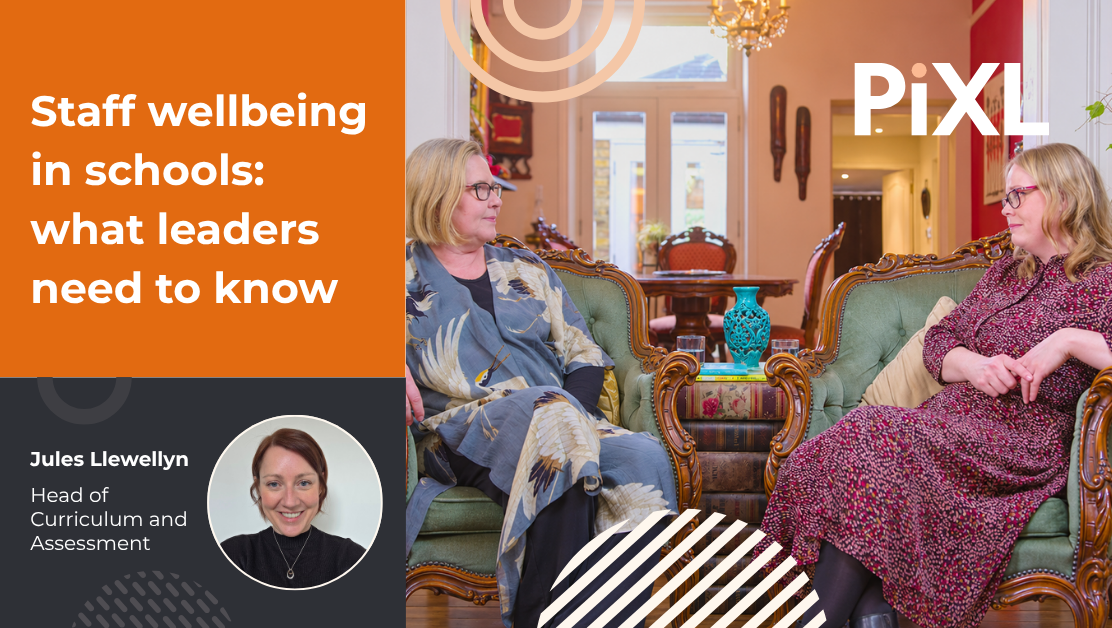
  • Staff wellbeing in schools: what leaders need to know 

    Staff wellbeing in schools: what leaders need to know 

    10 minute read

    Staff wellbeing is on every school’s agenda, but it is often misunderstood. When PiXL CEO Rachel Johnson sat down with Dr Emma Kell, their conversation went a long way past the cake in the staff room. Emma is a teacher, leader and coach with 27 years in UK secondary schools, a doctorate on teacher wellbeing and parenting, and books including How to Survive in Teaching. 

    Most of Emma’s career has been positive. Two years were not. She had chosen a school that didn’t fit her values and tried to prove herself by working 70 or 80 hours a week, often going from Monday to Thursday without seeing her two young children. 

    “When you’re not enacting your values, it makes you ill,” she says. By the end, she had stopped talking. Her husband would ask about her day, and she had nothing to say. 

    If you lead a school, some of this may sound familiar. You may notice it in yourself, or in a colleague who has lost their spark. Emma’s point is that it doesn’t have to be this way, and that leaders are well placed to change it. Here is what she told us about what wellbeing really is, what it isn’t, and how you might apply it in your own school. 

    What wellbeing isn’t 

    Wellbeing is not the cake in the staff room. It is not the compulsory yoga session after school on a Friday, either. Emma has seen exactly that, and the response from many staff was predictable: “I want to go home.” 

    It’s the right sentiment with the wrong output. The school decides what will make people feel better, then asks them to give up personal time they could have used to recharge in their own way. Wellbeing is also not asking “How are you, really?” and following it with a request for a document that was due last Tuesday. And it isn’t about being happy all the time, or leaders pretending everything is fine, so no one worries. 

    So, what is it? For Emma, it comes down to self-efficacy. “No one goes into teaching for an easy life,” she says. “The best form of wellbeing is going home on a Friday feeling tired but knowing you’ve made a difference.” 

    For leaders, the test is simple: does this initiative add to staff’s load, or take something off it? 

    People pleasing and the wellbeing paradox 

    Many people come into teaching to make a difference. Emma argues that this is also where the trouble can start. 

    Making a difference feels good, so we do more of it. And there is always more to do: a thousand students, a hundred staff, endless injustices to put right. We keep giving time and energy until the thing that once brought us joy no longer does. 

    It’s a trap people pleasers fall into easily, and Emma calls it “the wellbeing paradox”. To break the cycle, she turns to organisational psychologist Adam Grant’s idea of “otherish giving”: 

    • Selfless givers say yes before the question is finished. Extra cover, the canteen duty, the Saturday event: “I’m flexible, I’m indispensable.” 
    • Otherish givers are just as generous, but they give with a purpose in mind. This course will help my students. This favour helps a colleague I trust. Crucially, they can say no. 

    Otherish givers have boundaries. If your hand goes up before the question in briefing has been finished, you may recognise the selfless giver in yourself. As a leader, look out for it in your team too. Notice who always volunteers, and share the load, so your most generous colleagues don’t burn out on your behalf. 

    Saying no without guilt, at every level

    Emma knows what it is to be a middle leader with too much to do and no obvious way to say no. There’s pressure from above and pressure from your team, and when you’re exhausted, your ability to prioritise and stand up for yourself is the first thing to go. 

    Her first piece of advice to middle leaders is to be honest. People can tell when you’re pretending, and a leader who shows their department how they navigate a hard week gives them permission to be human too. 

    Her second is to deal in facts, not feelings. Instead of “I’m drowning,” she suggests something like this: 

    “I can see this is important. Here’s what’s already on my plate. What would you like me to take off it so I can do this?” 

    Two words do a lot of the work here: 

    • Capacity. “I don’t have the capacity for this at the moment” is calm and hard to argue with. 
    • Reasonable. “It would be reasonable for me to deliver this in three weeks” moves the conversation on to what can be done. 

    For senior leaders, the question is what happens when that conversation lands on your desk. If a middle leader brings you their plate, the most useful response is to help them decide what comes off it. When your team knows it’s safe to say no to you, they are far more likely to tell you when they’re struggling. 

    That starts with your own example. Emma notes that many heads feel they must look fine all the time, so no one worries about them. Being honest about your own capacity shows your team that saying no is allowed at every level. 

    Rachel adds another technique: “no, because”. “I’m saying no to you because I’m saying yes to my children.” Naming what the yes protects makes the no easier to say, and easier to hear.

    Leading wellbeing by example to prevent burnout 

    Whether you’re the caretaker, a trainee teacher or the CEO, someone in your building wants to be like you. If it isn’t one of the adults, it will be one of the students. 

    Emma shares three lessons she took from conversations with Dr Karen Edge about her Global City Leaders research into young school leaders. They are simple enough to test tomorrow: 

    • How fast do you walk? Unless you’re training for a marathon or teaching PE, slow down. Rushing down a corridor tells everyone, and your own body, that there’s an emergency when there isn’t one. 
    • How many bags do you carry? Every Friday, someone watches a colleague load a suitcase of marking into their car and concludes that weekends are for work. Most of those bags come back on Monday unopened. 
    • Are your basic needs being met? The burned-out leaders weren’t using the toilet at work, because they weren’t eating or drinking. They had lost sight of what they needed, let alone how to get it. 

    None of this is deliberate. When leaders are focused on getting the job done, they rarely stop to think how their own habits look to everyone else: the rushed walk, the bags of marking, the skipped lunch. If you can’t yet change them for your own sake, Emma suggests changing them for the people who love you and the people who work with you. They are watching more closely than you think. 

    Making time to think 

    We are in the business of teaching people how to think, yet teachers rarely get time to do it. Even protected time like PPA can disappear into a cup of tea, a string of interruptions and the bell. The best ideas tend to arrive when we step away: the psychologist Graham Wallas called this incubation, the stage that lets illumination happen. Emma’s coach has her own name for it: “staring at the wall time”. 

    Schools can create it. Encourage a 20-minute walk at lunchtime. Open a quiet room, or even the sensory room, to staff having a hard day. And when leaders spend time off site, it gives them space to think and shows their team they’re trusted. One deputy told her head: “You tell me I’m brilliant, but you never leave me on my own to get on with it.” 

    Meetings are the other obvious place to start. Rachel runs leadership meetings at PiXL to a few clear rules: 

    • Everyone knows beforehand whether the meeting is for discussion, decision or exploration. 
    • Papers are read and feedback is given in advance, so time together goes on what’s contested. 
    • Big decisions get a cooling off period of a few days, giving ideas time to settle rather than being made on the spot. 
    • Meetings finish on time. Every minute over builds resentment, especially for anyone with a childcare pickup. 

    For senior leaders, protecting thinking time starts with your own diary. 

    Why good enough protects well being 

    Perfectionism is one of the quickest routes to exhaustion, and Emma believes many teachers have perfectionist tendencies. Praise doesn’t help: “well done” just becomes proof that the task must have been easy. That is why she argues for “good enough”, which many people hear as lowering standards. 

    Emma learned this early. In her twenties, she taught languages with puppets, costumes and a buzzer, and her whole department worked the same way. The students loved the lessons, but the team had been so busy entertaining that no one had checked the exam specification, and results suffered. All that effort had gone into the wrong things. 

    For leaders, this is a wellbeing decision as much as a teaching one. If the lessons that get noticed and praised are all singing, all dancing ones, staff will keep working late to produce them. Making it clear that reliable, decent teaching is the standard gives people permission to stop. Headteacher, Helena Marsh, refers to this as the “daily diet”, if it is consistently good, the results will be excellent.  

    Why wellbeing is not selfish

    Wellbeing isn’t a bolt on, Emma says. It’s the professional learning, the communication, the meetings, the marking policy and the relationships in a school. Getting that right is a moral imperative and a practical one. 

    What gives Emma hope is a room full of new teachers. Whether they’re 22 or 52, they have chosen teaching despite the headlines. What makes her angry is watching people like them burned out by practices that could be changed. 

    “If we want to make a difference, we have to be well,” Emma says. “It is not a selfish act. If we’re worn-out husks, what message are we sending, as role models to young people? ”  

    For leaders, the question is less about what your school offers for wellbeing and more about what its everyday habits say to staff. Start small: end the next meeting on time, leave the bags at school on Friday, and make it safe for your team to say no. Your staff will notice, and they will follow. And it isn’t yours alone to carry. As Emma puts it, every adult in a school has more control than they think.

    PiXL members, watch the full conversation here. 

    Not a PiXL member? Find out more. 

  • Handling tension in school as senior leaders

    Handling tension in school as senior leaders

    It’s part-way through the autumn term and you’re in the thick of it. Your team is stretched, and you can already see the conflict brewing, right when you’re meant to be building a culture where people feel like they matter. This article looks at the pressures senior leaders are dealing with right now.

    Carrying tension in the team: the meeting after the meeting

    You know the moment. The SLT meeting ends, everyone nods, and the real conversation starts in the car park. Or two colleagues have stopped speaking, and you can feel it every time you walk into the staffroom. Or the cover rota has become a battleground again.

    Every senior leader I know carries tension somewhere in their team. Most of us were never taught what to do with it. We were trained to teach, to plan and to analyse data, but not to tell the difference between friction that is wearing our team down and friction that is making us better.

    Destructive tension warning signs

    Destructive tension is friction that usually comes from a lack of clarity, or things that need to be said but aren’t. Your job is to spot it early, before it builds. Look out for: 

    • People not feeling heard: In meetings, some people are silent and others dominate. How do you make sure everyone has a voice and is heard?
    • Lack of clarity: people trying their best but not knowing “what done looks like” as it hasn’t been made clear.
    • Conflict and disagreement: when something is brewing but has not been addressed.

    Not all tension is bad

    Here is the thing I have come to believe: the absence of tension is not the same as a healthy team. Some of the most worrying teams I have seen are the ones where everyone is lovely and nobody ever disagrees.

    Adam Grant draws the distinction in Think Again. Relationship conflict is personal, while task conflict is a disagreement about the work. The research backs him up. A major review of 116 studies, covering nearly 9,000 teams, found that personal conflict consistently drags teams down, while disagreement about the work can help, if it stays about the work.

    So the question for leaders is not “how do I get rid of tension?” It is “which tension should I resolve, and which should I protect, or even create?”

    What we will explore together

    That is what our first session of the Senior Leaders Programme, Resolving and creating tension, is all about. It is practical, research-informed and rooted in the realities of school life. In the session, we will look at:

    • How to tell good tension from bad. Some disagreements that look like debates about ideas are really about something else entirely. Once you can spot the difference, the way forward often becomes clearer.
    • How to face and resolve unhelpful tension. Many of us avoid hard conversations because we want to be kind. We will look at what gets in the way, including the traps we all fall into under pressure, and how to go into a difficult conversation in the right frame of mind.
    • How to make the right things easier and the wrong things harder. Schools are brilliant at adding things: another meeting, another form, another initiative. Research shows we are wired to add rather than subtract. We will look at how to spot the friction draining your staff, and the friction worth keeping.
    • How to create the right kind of tension on purpose. Asking someone to play devil’s advocate sounds like a good idea. The evidence suggests it often backfires. We will explore what works instead, and why one genuine dissenter can improve a group’s thinking even when they turn out to be wrong.

    You will leave with a workbook, a set of tools you can use in your very next SLT or department meeting, and three commitments for the half term ahead.

    Who it is for

    The Senior Leaders Programme is for headteachers, deputies, assistant heads and anyone leading a team through change. If you have ever left a meeting knowing the real issue was never named or wondered whether your team is a little too comfortable, this is for you.

    Bring the tension you are carrying

    Before we start, I will ask you to name one tension you are carrying in your team right now. Most leaders find they have one ready. By the end of the session, I hope you will know whether to resolve it, reframe it or use it.

    Tension is not going away. But it can become one of the most useful tools a leader has. I would love you to join us.

    Senior Leaders Programme sessions

    SessionsThemesDates
    Session 1Resolving and creating tensionThursday 8th October 2026
    Session 2Cynicism versus scepticismWednesday 11th November 2026
    Session 3Mattering, belonging and joyThursday 10th December 2026

    Book your place on the sessions here.