Tag: wellbeing

  • The Milburn Review: three takeaways for school leaders

    The Milburn Review: three takeaways for school leaders

    3 minute read

    Young people don’t become NEET (not in education, employment or training) overnight. For many, detachment starts while they’re still at school. That’s why the Milburn Review matters to schools.  

    A lot has been said about it this week, and there’s plenty more to come. We’ve been reading it carefully with our members in mind. Here are our first three takeaways.  

    1. Looking beneath the label  

    What the review says

    “The NEET label conceals as much as it reveals. The question now is not simply how many young people are outside work and learning, but how they got there […] and what would reconnect them” (paragraph 178). 

    PiXL’s take

    We welcome this. A number on its own can’t tell a school what to do next. Our working party of school leaders, set up to look at the NEET challenge, has been trying to get upstream of exactly this issue by asking two questions. What are the barriers facing the young people most at risk of becoming NEET? And what can schools do about them? 

    2. From detachment to connection 

    What the review says

    “NEET is the statistical description of the problem, but detachment is the process that produces it” (paragraph 359).  

    The review calls for joining up services that too often stop and start at institutional boundaries and proposes that every young person at risk should be known well by an adult in school. 

    PiXL’s take

    We agree, and we think the answer is connection. That has to happen at every level.  

    • The system: the review is clear that this isn’t on schools alone. Many schools are already joining up services around their students, as our book “How do you do belonging?” shows. 
    • The sector: sharing ideas, practice and approaches between schools builds the collective knowledge no single school can build alone. Our network is built on schools doing exactly that. 
    • The individual: making sure every young person at risk is known well by an adult in school is something we can make happen now. If you want to start here, our recent conversation with the Lost Boys Taskforce on the Trusted Adult Guarantee is a useful place to begin.  

    3. What gets measured 

    What the review says

    “What government chooses to measure tells institutions what government believes matters” (paragraph 439). 

    PiXL’s take

    Exam results matter. But the civic and social contribution of schools goes well beyond them. We’d welcome government taking a broader view of success, if it gives school leaders more agency to respond to their communities, without adding another framework to comply with. 

    Schools don’t have to wait 

    Policy moves slowly. Much of this review sets out a plan to redesign the system over the next 10 years.  But schools don’t have to wait. They can start now by nurturing relationships, staying curious about the barriers young people face, and defining success on their own terms.  

    We know different schools will have different takeaways from this review. We’ll keep reading and keep you updated. As always, we’re here to stand with you. Tell us what your school takes from it”, 

    For more policy updates, visit our blog 

  • Comparison-itus: the leadership edition 

    Comparison-itus: the leadership edition 

    8 minute read

    Comparison is part of leadership. The question is whether it’s helping you or holding you back…

    Do you ever look at another school’s results or social media posts and feel your stomach drop, just a little? If you do, you’re not on your own. When I wrote about comparison-itus for young people, in ‘Connected: Focusing on Me and We’, I called it an epidemic. What I didn’t say in that chapter is that it doesn’t stay in the classroom. It walks straight down the corridor, into the head’s office, sits down and makes itself a cup of tea. 

    In this blog I want to look at three things: what comparison does to our confidence as leaders, how to tell when it has tipped from helpful to harmful, and what we can do about it, on our own and together.  

    The sinking feeling: mad, bad or sad? 

    I want you to think about the last time you sat in a meeting, scrolled through LinkedIn or stood chatting at a conference and felt that familiar sinking feeling. How many do you recognise from the list below? 

    The results-day refresh: You’ve celebrated your outcomes with your team. You’re proud. Then another school posts theirs. Suddenly your good day doesn’t feel quite so good. 

    The staffing sigh: You’re carrying three vacancies and holding cover together with goodwill and sticky tape. Another head mentions, almost in passing, that they had forty applicants for their maths post. Forty! What?! How?! 

    The report card ripple: A neighbouring school’s inspection report lands, with strong grades across the board. You read every line. Twice. Then you go back and reread your own and start to feel anxious. 

    When we are kids, we want to keep up with everyone else. When we become leaders, the same voice rises within us: ‘everyone else seems to be managing.’ We perceive we’re being left behind. That grows into thinking everyone else has it better than us. Then we can get dissatisfied and we choose mad, bad or sad. 

    • When we choose mad, the frustration leaks out. It shows up in the SLT meeting. We push harder, demand more and launch another initiative because someone else has something we don’t. We can lose our patience and focus on quick fixes. 
    • When we choose bad, we start making decisions for the comparison rather than for our students. We chase the measure.  We make decisions that have not been thought through. We copy a strategy that works brilliantly in someone else’s context and wonder why it doesn’t work in ours. 
    • When we choose sad, it’s harder to spot. It looks like imposter feelings, a dread before meetings, interrupted sleep and a creeping sense that maybe we’re not cut out for this. We might call it ‘tired’ or ‘weary’ because they are the big overarching words, but underneath there can be disappointment, anxiety, embarrassment and loneliness.

    Why this matters: confidence and efficacy 

    This isn’t just about feeling a bit down on a Tuesday. It goes to the core of how we lead. 

    Albert Bandura, the psychologist who gave us the idea of self-efficacy, described it as our belief in our own capability to act and to make things happen. One of the main ways that belief is built is through watching others. When we see someone like us succeed, our belief grows: if they can, I can. That’s comparison working for us. 

    But, when we compare ourselves with someone whose context is nothing like ours, or when all we can see is their highlight reel, that same mechanism flips. Instead of ‘if they can, I can’, we hear ‘they can, so why can’t I?’ Belief drains away. And efficacy isn’t only about how we feel, it’s about what we’re prepared to attempt. Leaders who doubt themselves play safe. They avoid the difficult conversation, hold back on the bold decision and stop taking the considered risks that improvement needs. 

    It also spreads. Teams read their leaders. If you walk back from a network meeting deflated, there is a risk your staffroom will feel it before lunch. Our emotional leakage reaches places we never thought possible, just like the water leak does in your school. 

    Do you have it? A symptom checker for leaders 

    • I feel a dip when I see other schools’ results, even when ours are good. 
    • I compare headline numbers without considering context: intake, starting points, staffing, budget and history. 
    • I measure our school against other people’s highlight reels (the LinkedIn post, the conference slide) and forget they’re edited too. 
    • I’m tempted to adopt a strategy because a ‘successful’ school uses it, not because it solves our problem. 
    • I leave network meetings feeling less capable than when I arrived. 
    • I hear myself say ‘we’re not like them’ as a reason not to try, rather than as useful context.

    If you gave yourself a score between 1 and 10 for how badly you suffer with comparison-itus, what would it be? (10 means ‘I always compare our school to others negatively’.) Now, be honest: what would your senior team score you? 

    Surprise! Some comparison is a good thing

    You might assume, having read all this, that I’m about to tell you to stop comparing altogether. Nope. Some comparison is genuinely useful. The trick is to do the right kind of comparing. 

    Comparison gives us context 

    Imagine your attendance dips this half term. Is that a crisis or a pattern? Until you compare with similar schools, locally and nationally, you can’t really know. Benchmarking is part of good diagnosis and looking at similar schools can be really helpful. The key word is similar. Comparing ourself with a school that has a different intake, a different budget and a different history can give us ideas, but may not help us in our own context. Compare to diagnose, not to despair. 

    Comparison shows us where we can add something special 

    In a sports team, the coach compares players to put each one in their strongest position. The same is true across a group of schools. If your school is brilliant at early reading and the school next door has cracked attendance, the comparison isn’t a ranking, it’s a map of who can help whom. That makes everyone stronger. 

    Comparison brings perspective 

    On the hard days, it helps to think of colleagues who have led through things far tougher than our current problem. They came through, and we can too. It also helps to make the most honest comparison of all: your school now against your school three years ago. When we only compare sideways to others, we forget to look back and see how far we’ve come ourselves. Compare where you are now with where you were three years ago.  It may help bring perspective. 

    Comparison can inspire us to change 

    If you compare your roll with the oversubscribed school down the road, you’ll probably just feel worse. But if you ask how they got there: what they did with transition, how they talk to families, what their open evening actually feels like, then that IS a helpful comparison. It spurs you on to DO something. The question to ask isn’t ‘what have they got?’ It’s ‘what did they do, and would it work here?’ 

    What can we do?  

    Me (what I can do) 

    • Notice your triggers. Results season, inspection reports, LinkedIn, certain meetings. Be mindful of what your emotions are doing and step away when you notice that sinking feeling. 
    • Flip the narrative. Swap ‘why can’t we be like them?’ for ‘what can I learn from them?’ 
    • Compare like with like, and with your own past. Context isn’t an excuse, it’s data worth noticing. 
    • Find a worthy rival. Simon Sinek talks about this in The Infinite Game: a school you admire, perhaps one that slightly irritates you, or whose strengths reveal where you can grow. Then pick up the phone. In my experience, most leaders are incredibly generous when asked ‘how did you do that?’

    We (what we can do) 

    • Make comparison a diagnostic tool, not a stick. When someone in SLT brings a comparison to the table, ask together: what does this tell us, and what’s the context? 
    • Celebrate your people for what they do, not against others. ‘School X does this better’ rarely motivates anyone. ‘Here’s what we’ve learned from school X’ often does. 
    • Share honestly across your network, including the messy bits. The best antidote to a highlight reel is the truth. The moment one leader says ‘actually, we’re struggling with that too’, comparison-itus loosens its grip on the whole room and we all feel more seen and understood. 
    • Play the infinite game together. The point isn’t to beat the school next door this year. It’s to keep getting better, and to help each other do it. 

    We will always compare ourselves. It comes with being human, and with being a leader, I’m afraid. But if we do it the right way, we protect our confidence, we strengthen our teams’ belief that they can make a difference, and our students feel the benefit. 

    So next time you feel that familiar dip, pause and ask yourself: is this comparison making me better, or just making me feel worse? How can I pivot? 

    PiXL members, for more practical leadership tools, join our Stronger Leaders Programme  

    Not a PiXL member? Find out more 

  • Exam anxiety: what every leader needs to know and do before mocks 

    Exam anxiety: what every leader needs to know and do before mocks 

    6 minute read

    Every leader has seen it. A student who knows the material walks into the exam hall and can’t write a word. 

    It’s easy to call those nerves. The research calls it test anxiety, and it’s far more common than most schools assume. Between 12% and 18% of secondary students are severely affected by it. That’s four or five students in every class of 30. 

    It matters for two reasons. Highly anxious students achieve lower grades than equally able classmates. It also does real harm to their wellbeing. 

    Mocks are the moment to act. There’s still time to change what students experience before the summer, and a poorly handled mock result can entrench negative self-belief at exactly the moment revision needs to accelerate. 

    In this blog, we explore how leaders can pinpoint the students most at risk from exam anxiety, and the practical steps they can take to create the best conditions for every student to thrive. 

    The students you might not see

    Any student can experience exam anxiety, but some are far more likely to. Girls are around twice as likely as boys to report it, and the gap widens through secondary school. Students with SEND face extra demands on working memory, reading, and processing speed. Perfectionists, students from disadvantaged backgrounds and those with conditional offers riding on results are all at higher risk. 

    Then there are the boys who look fine. 

    Boys are more likely to cope through avoidance: distracting themselves, playing down the exam, refusing to think about it (Ofqual, 2020). They may also be less likely to share their worries, so a school that waits for students to come forward risks missing anxious boys. 

    What leaders can do: Look for anxiety rather than waiting for it to show. A short questionnaire in Year 9 or early Year 10 can identify who needs targeted support, well before exams. Look for patterns in your data by gender, SEND, year group, subject or socioeconomic background, including groups less likely to disclose anxiety, and identify students eligible for access arrangements proactively, well before Year 11. 

    Why students go blank 

    The brain’s stress response can’t tell the difference between a predator and a GCSE paper. When a student sees an exam as a threat, adrenaline, cortisol and noradrenaline do what they evolved to do: racing heart, shaking hands, a mind that will not switch off. 

    The worries that follow, such as “I’m going to fail” or “everyone else knows this”, compete for the same working memory the student needs to answer the question. The knowledge has not gone, the student just can’t reach it. 

    Some students freeze altogether, sitting motionless and aware that time is passing. To a teacher, that can look like a lack of effort. It’s a recognised physiological state, and seeing it that way changes how staff respond. 

    It also explains why “a bit of stress is good for you” is only half true. A bit of pressure helps students who see it as a challenge they can meet. For students who see it as a threat, the same pressure produces anxiety, not motivation. 

    What leaders can do: Make sure staff recognise that a student who appears disengaged or paralysed in a mock may be experiencing a freeze response, not a lack of effort or ability, and that they respond with support, not sanctions. 

    When good intentions backfire 

    “If you don’t revise, you won’t get into sixth form.” “These results will follow you for life.” Teachers say these things in good faith, hoping to spark effort. Researchers call them fear appeals. For confident students, they can work. For students without that self-belief, they register as a threat and make anxiety worse. 

    Here’s the part that matters most to leaders. Teachers are more likely to use fear appeals when they feel accountability pressure themselves. Around 70% of teachers say their own stress sometimes affects how they interact with students. Students pick it up through tone, body language, and urgency, even when nothing is said. 

    What leaders can do: In exam season, absorb accountability pressure rather than pass it on to departments and teachers, and keep data conversations focused on support. Pressure passed down from leaders reaches the classroom, so protecting staff is not only about their wellbeing. It is part of the strategy for student outcomes. 

    Five things to do before mocks 

    None of these needs a specialist or a new budget line. 

    1. Listen to the language. Walk the corridors, read the displays, and sit in an assembly. Are the messages about exams threat-based or challenge-based? Build a shared vocabulary that is honest about stakes and focuses on what students can do to perform at their best. 
    2. Plan how mock results come back. Return them through a consistent process, with context and support available straight away. Anxious students need to leave knowing what to do next, not just what they got. 
    3. Teach students what anxiety is. Explain that going blank is the body’s threat response, not proof they don’t know the content, so it is understood rather than feared. Give all students regular practice in breathing and relaxation techniques, for example in tutor time: they cost almost nothing. 
    4. Try three minutes of writing. Writing about worries just before a high-stakes assessment improves performance. Make a short, private writing task part of the routine before each mock paper. 
    5. Manage the wait outside the hall. The moments before an exam, when students compare revision and quiz each other, are a known high-risk point. A calm, structured routine can replace them.

    Where to start 

    Exam anxiety isn’t fixed. The evidence is clear that schools can reduce it through deliberate action, and that leaders create conditions for everything else to work. 

    The PiXL Revision guide on exam anxiety brings the research together for senior and middle leaders. Alongside it, our self-audit turns that evidence into 18 questions you can work through with your team before mocks, with space to choose a small number of priorities that will make the biggest difference in your school. 

    Four or five students in every class are waiting to find out what this year’s exams will feel like. You still have time to change the answer. 

    PiXL members can find more revision support on the PiXL Portal.  

    Not a PiXL member? Find out more.  
  • Exam anxiety: a self audit for leaders 

    Exam anxiety: a self audit for leaders 

    7 minute read

    How to use this audit 

    Work through these 18 questions with your senior team before mocks, so there is still time to act before the summer series. The questions are adapted from the key questions for leaders in the PiXL Revision guide on exam anxiety. 

    Follow the steps below to get the most out of the audit: 

    1. Complete it as a team. Bring together colleagues with responsibility for leadership, SEND and pastoral care, as each will notice different things. 
    2. Rate each question red (R), amber (A) or green (G) using the rating system below and note the evidence behind your rating. 
    3. Keep all evidence at cohort or group level. Do not record named students in this document. 
    4. Choose a small number of red or amber items to prioritise before mocks and record them in the action plan at the end. 
    5. Revisit the audit after mocks, to review what worked and reset your priorities before the summer series. 
    RatingWhat it means 
    Red (R) Not in place, or left to chance. 
    Amber (A) Happening in places, but not consistent across the school. 
    Green (G) Embedded, consistent and understood by all staff. 

    Why this matters before mocks 

    Between 12% and 18% of secondary students experience high levels of test anxiety. That is four or five students in every class of 30 (Putwain and Daly, 2014).

    • It costs grades. Students with high levels of test anxiety perform below what their knowledge would allow, even when ability is taken into account (Ofqual, 2020). 
    • Preparation alone is not enough. 72% of UK students report feeling anxious even when well prepared for a test, against 56% globally (OECD, 2015). 
    • Mocks are a turning point. A poorly handled mock result can entrench negative self-belief at exactly the moment revision needs to accelerate. 
    • The anxious students are not always visible. Boys are more likely to cope through avoidance, so their anxiety can be harder to spot (Ofqual, 2020). 

    A bit of pressure helps students who see it as a challenge they can meet. For students who see it as a threat, the same pressure produces anxiety, not motivation (Putwain, 2024).

    Section A: understanding the picture in your school 

    Schools that wait for students to show distress will miss many of the most anxious, particularly boys, who are more likely to cope through avoidance (Ofqual, 2020). 

    # Question What green could look like Rating Evidence and notes 
    1Do you know which students are most at risk of exam anxiety, and do you have a structured way to identify them before the exam period? A short questionnaire in Year 9 or early Year 10 identifies who needs targeted support, well before exams .
    2Do you look for patterns in your data by gender, SEND, year group, subject or socioeconomic background? Leaders know where anxiety is concentrated, including groups less likely to disclose it. 
    3When students appear disengaged or paralysed in an assessment, do staff recognise this may be a freeze response rather than a lack of effort or ability? Staff understand that going blank is a physiological state and respond with support, not sanctions. 

    Section B: language and culture 

    Warnings about the consequences of failure, such as “these results will follow you for life” are used in good faith, but they raise anxiety in the students who are already most vulnerable (Putwain and Symes, 2014).

    # Question What green could look like Rating Evidence and notes 
    4Are the messages students receive about exams, from teachers, displays, assemblies and results events, mainly threat based or challenge based?Messages are honest about stakes and focus on what students can do to perform at their best
    5Do staff warn students about the consequences of failure to motivate them, either directly or through their tone? Staff understand that warnings about failure increase anxiety without increasing effective effort and use a shared vocabulary instead. 
    6Does your approach to mock exams and results days reduce or amplify anxiety? Mock results are returned through a consistent process, with context and support available straight away. 
    7Do students measure progress against their own previous best, rather than against each other? Students set personal best goals and are not ranked or compared publicly. 

    Section C: staff pressure and wellbeing 

    Around 70% of teachers say their own stress sometimes affects how they interact with students (Hutchings, 2015). Pressure passed down from leaders reaching the classroom. 

    # Question What green could look like Rating Evidence and notes 
    8Do leaders absorb accountability pressure in exam season, rather than passing it on to staff? Leaders deliberately absorb pressure rather than pass it on, and data conversations in exam season focus on support.
    9Do leaders recognise that protecting staff from exam pressure also protects students?Staff wellbeing is planned into the exam season calendar as part of the strategy for student outcomes. 

    Section D: curriculum and preparation 

    Preparedness is one of the most reliable buffers against anxiety. The strongest school programmes combine teaching students about anxiety, skill building, and cognitive strategies (Putwain et al., 2014). 

    # Question What green could look like Rating Evidence and notes 
    10Are students explicitly taught what exam anxiety is, why it happens, and what they can do about it? Every student learns this through PSHE, tutor time or assemblies, so going blank is understood rather than feared.
    11Are students taught study skills and exam techniques alongside subject content? Students practice managing time under pressure and approaching questions they find difficult. 
    12Are students familiar with formal exam conditions before Year 10 or 11? Students practice sitting in rows, in silence and under time pressure, in low-stakes assessments before Year 10.
    13Is exam preparation, including its emotional side, built into the curriculum rather than added at the end of Year 11?Exam preparation is sequenced across key stages, not bolted on in the final months.

    Section E: specific interventions 

    These are low cost and evidence backed. Writing about worries just before a high-stakes assessment improves performance (Ramirez and Beilock, 2011), and a three-minute task needs no specialist resource. 

    # Question What green could look like Rating Evidence and notes
    14Are students explicitly taught breathing and relaxation techniques? All students learn and practice these techniques regularly, for example in tutor time. 
    15Do students get a few minutes to write about their worries just before high-stakes assessments? A short, private writing task is part of the routine just before mocks and exams. 
    16Are access arrangements identified early for eligible students, or only in the final months before exams? Eligible students are identified proactively, well before Year 11. 
    17Is the pre-exam wait, when students gather and compare revision, actively managed? A calm, structured routine replaces last minute comparison outside the exam room. 

    Section F: parents and families 

    Monitoring revision time, criticising effort and making results the centre of family conversation all increase anxiety (Ofqual, 2020). 

    # Question What green could look like Rating Evidence and notes 
    18Are parents given clear, specific guidance on supporting their child through exams in ways that reduce pressure, including what not to say?Families receive practical guidance before mocks, covering helpful language and what to avoid. 

    Action plan: priorities before mocks 

    Choose a small number of red or amber items to prioritise. Fewer actions done well will do more than many started at once. You don’t need to fill every row. 

    Priority QuestionAction Lead By when How we will know it has worked 
    1
    2
    3
    4
    5

    PiXL members can find more revision support on the PiXL Portal. 

    Not a PiXL member? Find out more. 
  • Staff wellbeing in schools: what leaders need to know 

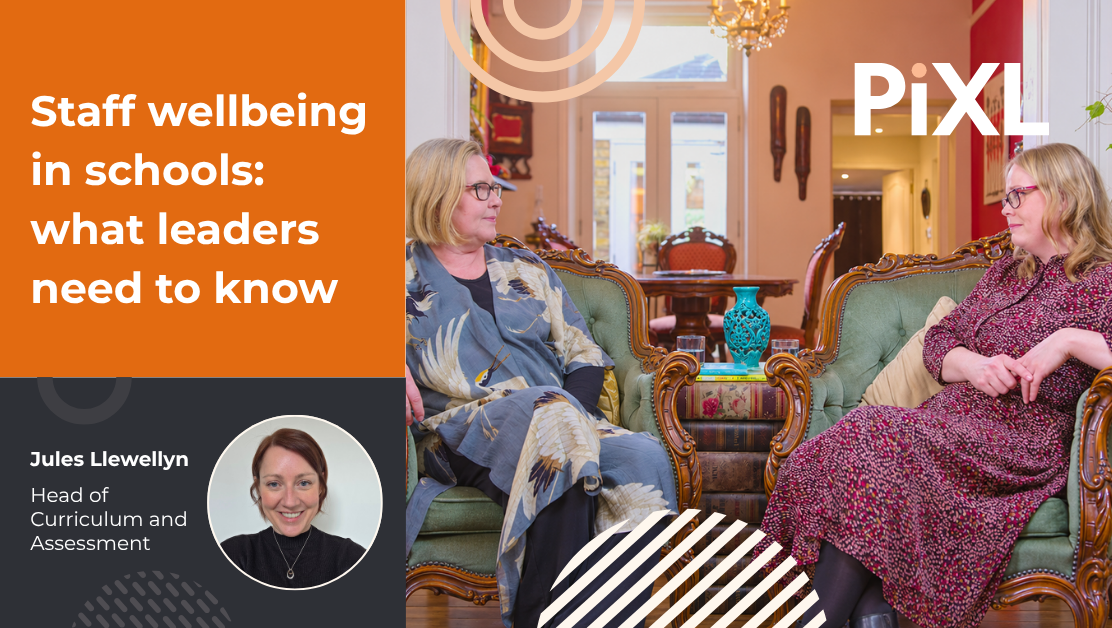
    Staff wellbeing in schools: what leaders need to know 

    10 minute read

    Staff wellbeing is on every school’s agenda, but it is often misunderstood. When PiXL CEO Rachel Johnson sat down with Dr Emma Kell, their conversation went a long way past the cake in the staff room. Emma is a teacher, leader and coach with 27 years in UK secondary schools, a doctorate on teacher wellbeing and parenting, and books including How to Survive in Teaching. 

    Most of Emma’s career has been positive. Two years were not. She had chosen a school that didn’t fit her values and tried to prove herself by working 70 or 80 hours a week, often going from Monday to Thursday without seeing her two young children. 

    “When you’re not enacting your values, it makes you ill,” she says. By the end, she had stopped talking. Her husband would ask about her day, and she had nothing to say. 

    If you lead a school, some of this may sound familiar. You may notice it in yourself, or in a colleague who has lost their spark. Emma’s point is that it doesn’t have to be this way, and that leaders are well placed to change it. Here is what she told us about what wellbeing really is, what it isn’t, and how you might apply it in your own school. 

    What wellbeing isn’t 

    Wellbeing is not the cake in the staff room. It is not the compulsory yoga session after school on a Friday, either. Emma has seen exactly that, and the response from many staff was predictable: “I want to go home.” 

    It’s the right sentiment with the wrong output. The school decides what will make people feel better, then asks them to give up personal time they could have used to recharge in their own way. Wellbeing is also not asking “How are you, really?” and following it with a request for a document that was due last Tuesday. And it isn’t about being happy all the time, or leaders pretending everything is fine, so no one worries. 

    So, what is it? For Emma, it comes down to self-efficacy. “No one goes into teaching for an easy life,” she says. “The best form of wellbeing is going home on a Friday feeling tired but knowing you’ve made a difference.” 

    For leaders, the test is simple: does this initiative add to staff’s load, or take something off it? 

    People pleasing and the wellbeing paradox 

    Many people come into teaching to make a difference. Emma argues that this is also where the trouble can start. 

    Making a difference feels good, so we do more of it. And there is always more to do: a thousand students, a hundred staff, endless injustices to put right. We keep giving time and energy until the thing that once brought us joy no longer does. 

    It’s a trap people pleasers fall into easily, and Emma calls it “the wellbeing paradox”. To break the cycle, she turns to organisational psychologist Adam Grant’s idea of “otherish giving”: 

    • Selfless givers say yes before the question is finished. Extra cover, the canteen duty, the Saturday event: “I’m flexible, I’m indispensable.” 
    • Otherish givers are just as generous, but they give with a purpose in mind. This course will help my students. This favour helps a colleague I trust. Crucially, they can say no. 

    Otherish givers have boundaries. If your hand goes up before the question in briefing has been finished, you may recognise the selfless giver in yourself. As a leader, look out for it in your team too. Notice who always volunteers, and share the load, so your most generous colleagues don’t burn out on your behalf. 

    Saying no without guilt, at every level

    Emma knows what it is to be a middle leader with too much to do and no obvious way to say no. There’s pressure from above and pressure from your team, and when you’re exhausted, your ability to prioritise and stand up for yourself is the first thing to go. 

    Her first piece of advice to middle leaders is to be honest. People can tell when you’re pretending, and a leader who shows their department how they navigate a hard week gives them permission to be human too. 

    Her second is to deal in facts, not feelings. Instead of “I’m drowning,” she suggests something like this: 

    “I can see this is important. Here’s what’s already on my plate. What would you like me to take off it so I can do this?” 

    Two words do a lot of the work here: 

    • Capacity. “I don’t have the capacity for this at the moment” is calm and hard to argue with. 
    • Reasonable. “It would be reasonable for me to deliver this in three weeks” moves the conversation on to what can be done. 

    For senior leaders, the question is what happens when that conversation lands on your desk. If a middle leader brings you their plate, the most useful response is to help them decide what comes off it. When your team knows it’s safe to say no to you, they are far more likely to tell you when they’re struggling. 

    That starts with your own example. Emma notes that many heads feel they must look fine all the time, so no one worries about them. Being honest about your own capacity shows your team that saying no is allowed at every level. 

    Rachel adds another technique: “no, because”. “I’m saying no to you because I’m saying yes to my children.” Naming what the yes protects makes the no easier to say, and easier to hear.

    Leading wellbeing by example to prevent burnout 

    Whether you’re the caretaker, a trainee teacher or the CEO, someone in your building wants to be like you. If it isn’t one of the adults, it will be one of the students. 

    Emma shares three lessons she took from conversations with Dr Karen Edge about her Global City Leaders research into young school leaders. They are simple enough to test tomorrow: 

    • How fast do you walk? Unless you’re training for a marathon or teaching PE, slow down. Rushing down a corridor tells everyone, and your own body, that there’s an emergency when there isn’t one. 
    • How many bags do you carry? Every Friday, someone watches a colleague load a suitcase of marking into their car and concludes that weekends are for work. Most of those bags come back on Monday unopened. 
    • Are your basic needs being met? The burned-out leaders weren’t using the toilet at work, because they weren’t eating or drinking. They had lost sight of what they needed, let alone how to get it. 

    None of this is deliberate. When leaders are focused on getting the job done, they rarely stop to think how their own habits look to everyone else: the rushed walk, the bags of marking, the skipped lunch. If you can’t yet change them for your own sake, Emma suggests changing them for the people who love you and the people who work with you. They are watching more closely than you think. 

    Making time to think 

    We are in the business of teaching people how to think, yet teachers rarely get time to do it. Even protected time like PPA can disappear into a cup of tea, a string of interruptions and the bell. The best ideas tend to arrive when we step away: the psychologist Graham Wallas called this incubation, the stage that lets illumination happen. Emma’s coach has her own name for it: “staring at the wall time”. 

    Schools can create it. Encourage a 20-minute walk at lunchtime. Open a quiet room, or even the sensory room, to staff having a hard day. And when leaders spend time off site, it gives them space to think and shows their team they’re trusted. One deputy told her head: “You tell me I’m brilliant, but you never leave me on my own to get on with it.” 

    Meetings are the other obvious place to start. Rachel runs leadership meetings at PiXL to a few clear rules: 

    • Everyone knows beforehand whether the meeting is for discussion, decision or exploration. 
    • Papers are read and feedback is given in advance, so time together goes on what’s contested. 
    • Big decisions get a cooling off period of a few days, giving ideas time to settle rather than being made on the spot. 
    • Meetings finish on time. Every minute over builds resentment, especially for anyone with a childcare pickup. 

    For senior leaders, protecting thinking time starts with your own diary. 

    Why good enough protects well being 

    Perfectionism is one of the quickest routes to exhaustion, and Emma believes many teachers have perfectionist tendencies. Praise doesn’t help: “well done” just becomes proof that the task must have been easy. That is why she argues for “good enough”, which many people hear as lowering standards. 

    Emma learned this early. In her twenties, she taught languages with puppets, costumes and a buzzer, and her whole department worked the same way. The students loved the lessons, but the team had been so busy entertaining that no one had checked the exam specification, and results suffered. All that effort had gone into the wrong things. 

    For leaders, this is a wellbeing decision as much as a teaching one. If the lessons that get noticed and praised are all singing, all dancing ones, staff will keep working late to produce them. Making it clear that reliable, decent teaching is the standard gives people permission to stop. Headteacher, Helena Marsh, refers to this as the “daily diet”, if it is consistently good, the results will be excellent.  

    Why wellbeing is not selfish

    Wellbeing isn’t a bolt on, Emma says. It’s the professional learning, the communication, the meetings, the marking policy and the relationships in a school. Getting that right is a moral imperative and a practical one. 

    What gives Emma hope is a room full of new teachers. Whether they’re 22 or 52, they have chosen teaching despite the headlines. What makes her angry is watching people like them burned out by practices that could be changed. 

    “If we want to make a difference, we have to be well,” Emma says. “It is not a selfish act. If we’re worn-out husks, what message are we sending, as role models to young people? ”  

    For leaders, the question is less about what your school offers for wellbeing and more about what its everyday habits say to staff. Start small: end the next meeting on time, leave the bags at school on Friday, and make it safe for your team to say no. Your staff will notice, and they will follow. And it isn’t yours alone to carry. As Emma puts it, every adult in a school has more control than they think.

    PiXL members, watch the full conversation here. 

    Not a PiXL member? Find out more.