Forty Seconds at Primrose Hill: Part 1 of 4. The pupils’ view.
Ask a child at Primrose Hill C of E Primary Academy what “compassionomics” means and you’ll get a blank look. None of them have heard the word. None of them know that the adults around them have built a deliberate strategy out of a piece of medical research, or that a 40-second conversation is being held with intent, or that anyone, anywhere, is measuring whether it works.
What they can do is describe their school. And when you listen to how they describe it, you’re hearing proof that the strategy works.
We sat down with two groups of pupils and asked them simple things. What do you look forward to? How do you feel walking through the gates? Who do you tell when something exciting happens? What would you say to a child who doesn’t go here? Not one question mentioned compassion, or care, or relationships. We wanted to hear what they reached for on their own, without prompting.
They reached for trust.
A place you can trust
The word came up again and again, unprompted. One child explained why she always says hello to a teacher in the corridor: “I just want to make a bigger connection, to know I can trust them.” Another, asked what colour the school would be, chose a bright one, “because it shows that there’s somewhere that you can trust, somewhere you could send your children to when they grow up a little bit.” That’s a primary-age child describing the school as a place safe enough to one day hand over their own children. They’re not performing for a camera. They simply think this is what schools are.
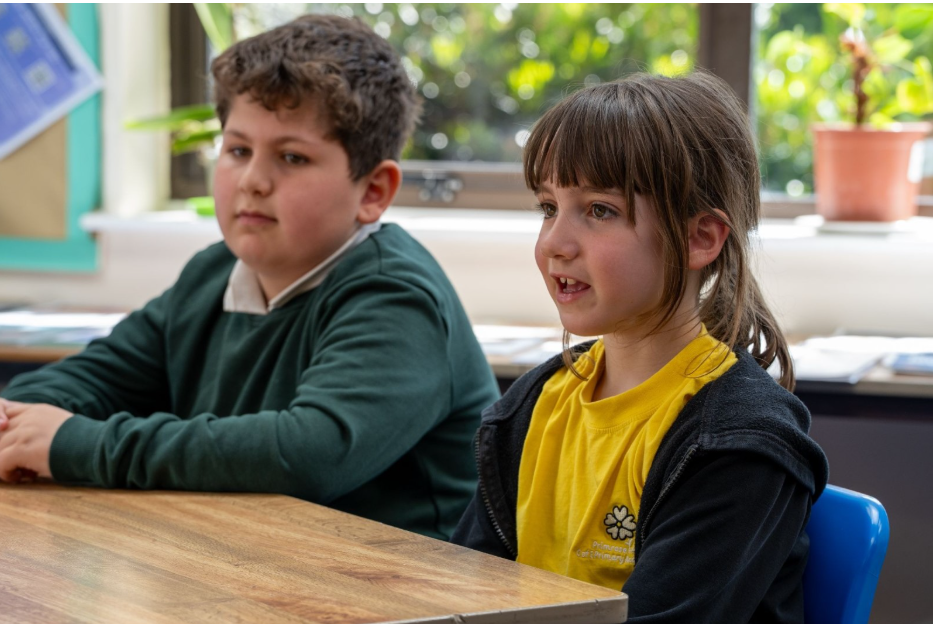
When we asked what happens on a sad or quiet day, the answers were practical and certain. “I would share my problems with friends or teachers.” “I would tell my friends, then later I’d also tell my teachers.” One child described going in a little early so there was private time: “I take that personal time to tell stuff.” A child has worked out that the adults at the door have a few unhurried seconds for them before the day begins and has decided to spend those seconds on the things that matter most to them. That’s the 40 seconds, seen from the other side of it.
They didn’t pretend bad days never happen here. They were matter of fact that they do. What they were sure of was where a bad day goes when it arrives: to a friend first, then to a teacher. Knowing exactly where to take it isn’t something a child works out alone. They learn it from adults who have made themselves available before.
They have the words for how they feel
We also asked how they feel walking through the gates in the morning, and the answers stood out less for their warmth than for their range. Not just “happy.” One child said “curious,” because she and her friends would be wondering what the day’s lessons might bring. Another said “comfortable,” and explained it: “I feel happy because I know the friends that are going to be there, I feel comfortable.” A third said “excited, because I’m ready to know what we’re going to do today.” These are children who can name a feeling and tell you where it comes from. That fluency isn’t a given at this age. The teacher whose interview comes later in this series talks about the work involved in getting ten-year-old boys to talk about feelings at all. Here, the youngest children already have the words, because the adults around them use them every day.
They notice who notices them
The pupils were clear that the warmth isn’t rationed. When asked which grown-up always makes them laugh or smile, one child widened the question out before answering it: “all the teachers, because they never say mean things to you, but they always just make you smile.” Another described the school to an outsider as “warm and friendly, because it’s hard to run into someone who doesn’t say hello, especially the teachers.”
Mr Parsons, the Year 5 teacher, came up by name more than once. The children rated him not for his lessons but for something quieter. He has “a very good sense of humour,” one said, “and I think he can just understand you as well.” The children had noticed exactly that: a busy adult who, in the middle of a normal school day, takes the time to understand them.
Second family
The phrase that stayed with us came when we asked them to describe the school to someone who doesn’t go there. “I would describe our school as a second family,” one child said, “because everyone here is like friends with each other.” Another landed on “a trustful place where you could laugh and have a nice time.” A third went broad and happy: “a happy school, because all the people here are really happy and they’re really nice.”
There’s a temptation, reading these back, to find them sweet and leave it there. We would push the other way. These are children with no vocabulary for the thing being done to them, describing its exact effect with total accuracy. The adults set out to build a school where every child feels heard, valued and safe enough to bring their worries through the door. Ask the children, who have never seen the plan, and that’s the school they describe.
One last thread is worth pulling, because it’s the one that shows up in results. The very first answer we got, when we asked what the children look forward to, was this: “I look forward to learning new things because I want to know more about the world.” That’s a line about curiosity, not about feeling safe, though the two travel together. A child who isn’t spending the morning bracing has attention left over for the world beyond the classroom door. The security is what buys the curiosity. For a leader weighing whether 40 seconds is worth the bother, that is the entire argument, from belonging through to outcomes, made by a seven-year-old who had no idea they were making it.
The strategy is invisible to them. That’s how you know it has worked.
Next in the series: the parents, who feel the same 40 seconds land on them at the gate. Then the teacher who started out unconvinced, and the head whose whole philosophy fits inside it. Primrose Hill is a PiXL member school in the Forest of Dean. They first heard about compassionomics through PiXL.
Further reading
Trzeciak, S. and Mazzarelli, A. (2019) Compassionomics: The Revolutionary Scientific Evidence That Caring Makes a Difference. Studer Group Publishing.