
Author: Aby Moore

  • Serious About Subtraction: The Quieter Discipline of Precision Leadership

    Serious About Subtraction: The Quieter Discipline of Precision Leadership

    There’s a passage in PiXL’s Serious About Subtraction Leadership Thinking Guide that tends to hit harder in leadership teams than its writers probably expected:

    “Sometimes, we are addicted to adding things to our list, our plans and our approach. Of course, adding things can be a very good thing, it is how we can improve and how we can change things. Doing more can really help but sometimes it can disguise the real problem and sometimes, it can even get in the way of our leadership and our effectiveness.”

    Most heads, if asked privately, would recognise some version of this in their own school. The harder question is what to do about it, particularly at this point in the year, when leadership teams are starting to look at next year’s improvement plan and the natural pressure is to make it bigger rather than tighter. The behaviour intervention from October. The literacy strand that began in January after the data analysis came in. The wellbeing piece that launched alongside the staff survey. The data review cycle that runs every six weeks because it always has. The new attendance protocol that came in after Easter. Each was introduced for a good reason and survived the review that followed. Each is still officially live.

    The pressure most leadership teams feel at this point is to add more on top of all this: a better MIS system, a new marking policy, another attendance initiative, training on Adaptive teaching, an oracy audit. The other available response, the one that tends to take more time and produce fewer visible deliverables, is subtraction

    Why subtraction takes longer to do well

    There are practical reasons subtraction is harder than addition. Adding produces something visible. It comes with a meeting, a launch event, a slide in a strategy document, a line in the autumn newsletter to parents. Subtraction has none of those affordances. There is no launch event for stopping a thing.

    It’s also harder because the work coming off the plan was usually introduced by someone still on the team, championed in a previous SLT meeting, defended in a Trust review. Letting it go can feel internally like a quiet admission that the original decision was wrong, which it usually wasn’t. Most things on a plan worked when they were introduced; the honest question is whether they’re still doing the work they were brought in to do.

    Most leadership teams underestimate the cost of never asking that question. Schools that only ever add eventually run out of operational room. Staff who came up through the adding years often keep pace, because the layers went on one at a time. New colleagues joining a school whose plan has been accreting for a decade frequently can’t see where to stand. Over time, the harder cost shows up as a loss of clarity. When every initiative is still officially live, the leadership team loses the ability to point at the small number of things that genuinely matter most this year.

    What subtraction actually requires

    Subtraction, properly done, is leadership work rather than housekeeping. Tidying the school improvement plan is the version anyone with a highlighter can do in an afternoon. The version that matters asks, honestly, which of the things we still do are genuinely moving us towards the outcomes we care about, and which are still here because the conversation about stopping never happened.

    Done well, the work needs a few things:

    The first is rigour about the criteria, made explicit rather than left to whoever happens to hold the most influence on the day. What earns its place against the outcomes we want for the children and young people in our schools, and what doesn’t.

    The second is care for the people involved. Some of what comes off the plan will be attached to colleagues who introduced it, defended it, or built their professional identity around it. Subtraction done carelessly creates damage that takes years to repair, and the work deserves to be done with that in mind.

    The third is the willingness to actually have the conversation in the room. Subtraction in theory is easy. In practice it means saying out loud what has been quietly understood for a while: that the literacy strand isn’t working in its current form, that the data review cycle is producing reports nobody acts on, that the line management structure introduced two years ago is creating more friction than clarity. The leaders who do this well tend not to outsource the conversation to a consultant or a survey.

    Questions worth taking into the summer term

    A handful of questions that tend to surface the most useful subtraction conversations in leadership teams:

    What did we add this year that hasn’t done what we hoped it would, and what are we waiting for before we say so?

    Which things on our plan are still there because they work, and which are there because they are what we did last year?

    If a new colleague joined our leadership team tomorrow, which parts of the plan would we explain apologetically?

    What would our most experienced staff say is getting in the way of their best work this term?

    If we removed one thing from the plan before September, what would it be, and who needs to be in the room when we decide?

    The questions are designed to make a leadership team look honestly at what its plan has become, including the parts that have become difficult to defend.

    Precision over volume

    The wider framing here connects to the theme of this year’s PiXL June Conference: precision leadership, which the conference materials describe as not doing more, but doing the right things with greater clarity and intent.

    Subtraction is one of the most practical forms that idea takes between now and September. Are you brave enough to stop the high-effort, low-impact initiatives and go into next year with a slightly shorter plan, held with more conviction? Schools that do tend to make more genuine progress than those carrying everything forward by default.


  • Are your pupils practising times tables they’ve never been taught?

    Are your pupils practising times tables they’ve never been taught?

    Walk into many primary schools and you’ll find times tables practice happening daily. Songs, apps, rapid-fire tests and homework grids. The commitment is clear, but without the right teaching behind it, that practice rarely produces the results schools are working toward.

    The desire to improve times tables knowledge is widespread. What’s less common is the teaching that makes that knowledge possible in the first place. There’s a difference between practising something and learning it.

    Practice assumes a degree of understanding is already in place, that a pupil has encountered a concept, made sense of it, and is now consolidating it through repetition. When that understanding isn’t there, practice doesn’t build fluency, it creates gaps.

    Practice without understanding isn’t enough

    Teaching multiplication means helping pupils understand what multiplication is and why it works. It means building a consistent approach, using the same language and representations across year groups, so that pupils accumulate understanding rather than starting from scratch each September.

    The heart of it is helping pupils see the relationships between facts. Times tables aren’t a list of isolated answers to memorise. They’re a connected system with patterns worth understanding. Knowing that 4 x 6 = 24 is a starting point. Understanding that 8 x 6 must be double that, or that 4 x 7 is just 4 more than 4 x 6, is what makes the tables useful. A pupil who can use what they know to work out what they don’t yet know is in a fundamentally different position from one who’s trying to hold 144 separate facts in their head.

    The same principle applies to the patterns that run through each table. The 9 times table has properties pupils can investigate and rely on. The relationship between the 2, 4, and 8 times tables is worth making explicit. These aren’t shortcuts or tricks. They’re the structure of multiplication, and understanding them is what allows recall to be reliable rather than fragile.

    When this kind of teaching is in place, practice becomes meaningful. Pupils are rehearsing something they have genuinely understood, which is when repetition produces the quick, accurate recall that the curriculum requires.

    Why it matters beyond the check

    The Multiplication Tables Check has rightly focused attention on times tables. But while the MTC measures whether pupils know their tables, it doesn’t measure how they got there. And the stakes extend well beyond the check itself.

    Accurate, quick recall of multiplication facts underpins a significant proportion of the primary maths curriculum and beyond. Pupils working with fractions need it. Pupils calculating area need it. When pupils reach ratio, proportion, and algebra, those foundations need to be secure.

    Where they aren’t, the difficulty pupils experience isn’t really about the new topic. It’s about the ground that was never securely laid.

    What schools can do

    The starting point is audit rather than acceleration. Before adding more practice time, it’s worth asking what teaching of multiplication is happening and whether it’s consistent across year groups.

    Are pupils being helped to see the relationships between facts? Are they being given the language to talk about what they notice? Is there a shared approach that builds understanding from year to year, or are teachers working in isolation with different materials and different methods?

    A consistent teaching framework, one that makes relationships explicit and builds understanding before rehearsal begins, will take schools further than additional practice time alone.

    PiXL’s updated multiplication tables package gives schools the framework and resources to build exactly that approach across their whole school. Members can access it here.

  • BELONGING is a leadership decision

    BELONGING is a leadership decision

    You can feel it when you walk into a school where belonging has been built deliberately. A member of staff greets a pupil in the corridor in a way that says: you matter here, and I know you. The staffroom conversations carry on past the bell. Leaders talk about their pupils by name, knowing their histories and what makes each of them distinct.

    You can feel the absence of it too and so can pupils.

    The schools doing this well aren’t always the ones with the most elaborate approaches. More often, they’re the ones where somebody, usually the headteacher, made a clear decision: we’re going to build this deliberately, and we’re going to keep at it.

    What does belonging actually mean here?

    There’s no single agreed definition of belonging, and that matters more than it might seem. Most schools would say it matters. But fewer have worked out what it looks like in their corridors and tutor groups, or what pupils and staff would say if you asked them directly whether they felt it here.

    That specificity matters, because without it, belonging stays as a value on a wall, acknowledged but not actively built. What would a pupil who felt like they belonged here look like, and what would they say if you asked them? Answering that question with real specificity, for your school and your community, is where the work begins.

    Belonging is both an outcome and a practice. It takes time to build and can erode quickly when it stops being a deliberate priority. It’s built slowly, in active partnership with the whole community, and requires leaders to stay intentional about it at every level.

    Why it matters

    The research case for belonging is well established. A 2018 meta-analysis by Craggs and Kelly found that a strong sense of belonging improves academic achievement, motivation, and engagement. These sit at the heart of what schools are held accountable for every year.

    Most leaders know this instinctively. The harder question is how deliberately they are building it.

    The challenge for leaders

    The most common mistake is reaching for solutions before asking hard questions.

    A school notices that pupils from certain backgrounds feel less connected to school life, and the response is to find a programme, a framework, something that worked somewhere else and bring it in.

    The problem is that there’s no single experience of disadvantage, or of SEND, or of being new to a school, or of any of the other circumstances that can put belonging at risk. What shifted things in one school may do very little in another, because the context shapes everything.

    For pupils with SEND in particular, the gap between their experience of belonging and that of their peers is significant, and it rarely closes without someone in leadership treating it as a specific priority.

    So, before the strategy, there has to be honest evidence-gathering. PiXL’s Diagnose, Therapy, Test, Revisit process is a useful discipline here. Have you gone direct to source? Many schools assume they know what their community’s experience of belonging looks like. Fewer have created the conditions for people to say honestly what isn’t working, without fearing the consequences. Are you listening in a way that invites challenge, or seeking confirmation of what you already believe?

    For families who may already be experiencing a lack of power elsewhere in their lives, being treated as equal partners in this conversation changes the quality and honesty of what they share, and that matters long before any strategy is in place.

    From values to action

    Sean Covey’s work on lead and lag measures, will be familiar to many PiXL schools, is relevant here.

    Lag measures are outcomes: attendance data, survey results, the numbers at the end of the year that tell you whether things shifted. They matter, but by the time you have them, the window to act in that moment has already closed.

    Lead measures focus on what’s happening now: the specific actions most likely to move the needle over time. And that matters for belonging because lead measures put the agency back with the leaders and teams closest to pupils every day.

    What might belonging lead measures look like in practice?

    Ensuring every pupil is spoken about in pastoral conversations, not only the ones already on a list, is a starting point. So is calling home with something positive once a week for pupils with a history of persistent absence, or giving new staff a proper check-in conversation in their first four weeks about how they are settling in and what they need, alongside whatever formal review process is in place.

    Belonging for the people who build it

    Kathryn Riley at the UCL Institute of Education has written compellingly about the link between agency and belonging, and it holds for staff as much as it does for pupils. Teachers who feel trusted, who have real room to make professional decisions, are far more likely to create that same experience for the young people in front of them.

    A school where staff feel their contribution is invisible will struggle to build belonging for pupils, however strong the intention. What does belonging look like for the adults in your building? The mattering matrix is worth applying here: do staff feel valued, and do they feel their contribution is actually making a difference? How confident are you that you know the answers?

    Getting started

    Belonging doesn’t arrive through a new policy or a fresh initiative. It’s built by people, in the small decisions that happen every day: whether a pupil is greeted by name, whether a parent feels heard, whether a new teacher feels like they’re part of something from their first week.

    The leaders making the most progress are the ones who started by getting specific about what belonging means in their school, about whose voices they are actually hearing and whose they aren’t, and about what they’re going to do differently and how they’ll know whether it’s working.

    That kind of specificity takes longer than finding an off-the-shelf answer. It’s what makes belonging something a school actually builds, year on year. And it’s the kind of leadership that pupils and staff notice every day, even when they couldn’t quite put it into words.

  • Most schools care about wellbeing. Fewer know where they stand

    Most schools care about wellbeing. Fewer know where they stand

    Last week’s blog post looked at why pupils’ wellbeing dips so sharply at transition and what schools can do about it. But transition is one moment in a much bigger picture, and many schools don’t yet have a clear view of what that picture looks like. 

    Wellbeing is on every school’s agenda. It’s in the strategy documents, in the CPD sessions and in the conversations that happen long before an inspector arrives. School leaders care deeply about the young people in their schools and work hard to show it.

    But caring about wellbeing and knowing where your school stands on it are two different things. And for many schools, it’s the second part that’s harder to answer honestly.

    There’s a difference between a school that has wellbeing provision and a school that has a clear, evidence-based picture of how that provision is landing. That difference matters more now than it ever has.

    Wellbeing isn’t one thing

    Wellbeing isn’t a single dial that turns up or down. It’s a collection of interconnected dimensions, each of which affects the others in ways that are easy to miss when you’re focused on the most visible pressure point.

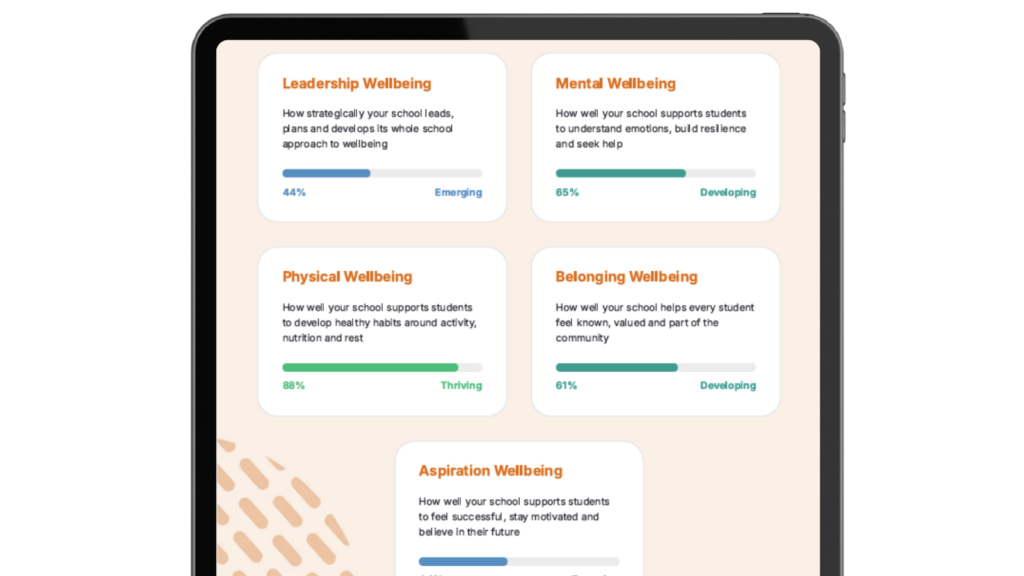
    At PiXL, we think about pupil wellbeing across four domains: mental wellbeing, physical wellbeing, belonging, and achievement and aspiration. Each matters in its own right, but it is often the connections between them that give schools the clearest insight.

    A pupil who’s struggling to feel like they belong will often show it in their mental wellbeing, and that knock to their sense of self follows them into the classroom. Poor physical health directly affects a young person’s capacity to learn, whether that shows up as inadequate sleep, limited activity or inconsistent nutrition. And aspiration without the support structures to reach it leaves pupils in a place that looks like disengagement from the outside but is something more complicated underneath.

    Whole school approaches that work, do so because they hold all four domains in view at once. That requires a framework. And a framework has to start with knowing where you are.

    What the evidence is saying

    The evidence on pupil wellbeing right now is asking school leaders to take it seriously.

    Edurio’s survey of 184,000 pupils from Year 4 to Year 13 points to a sustained decline in pupil wellbeing over time. Children report lower levels of happiness at school and higher levels of stress. The number of pupils who say they have a trusted adult in school is also falling, which matters deeply given the role trusted relationships can play in helping children feel safe, known and supported.

    The Parentkind National Parent Survey 2025 found that one in five children are unhappy at school. That’s two million young people. Children from low-income households are twice as likely to be bullied as those from higher-income families, and social isolation is cited as the cause of unhappiness by 35% of unhappy primary pupils. 177,000 children in primary schools alone who feel they don’t have a place where they fit. That number should stop us in our tracks. 

    The Children’s Society’s Good Childhood Report 2025 shows that girls continue to report lower wellbeing than boys across a range of areas. This is an important pattern for schools to understand, particularly when considering whether their wellbeing provision is reaching different groups of pupils in the right ways. 

    The Education Endowment Foundation’s research on social and emotional learning shows that evidence-based SEL interventions add three months of additional academic progress in a year. Wellbeing and school improvement aren’t separate agendas. They never were. 

    Ofsted’s current inspection framework includes personal development and wellbeing as an evaluation area, which makes it even more important that schools can explain their approach as well as their strengths and areas for development clearly. 

    1 in 5 children are unhappy at school. Over time, the picture on pupil wellbeing has become increasingly concerning.

    Knowing where you stand

    Most schools have wellbeing provision: pastoral systems, PSHE programmes, and staff trained in mental health first aid. Some have been building this carefully for years and it’s making a real difference.

    The research on what makes whole-school wellbeing approaches work is consistent on one point: they start with honest self-assessment. Understanding where you are is what makes everything that follows purposeful rather than well-intentioned but scattered. 

    When you know where your school stands across all four domains, you can make decisions about where to put your weight. You can see which areas are already strong and which need focused attention. And you can connect your wellbeing strategy to your wider school improvement priorities, rather than running it alongside them as a separate concern.

    Schools that have that picture are in a stronger position to make purposeful decisions for pupils, staff and the wider school community, with a clearer understanding of what’s working and where further support is needed. 

    There’s a fifth dimension too, and it’s the one most directly in the hands of the person reading this: the leadership of wellbeing itself. How wellbeing is prioritised, talked about and embedded in a school’s daily culture shapes what’s possible across all four domains. It goes beyond having a wellbeing lead or a strategy document. It’s whether the people who set the tone for a school treat wellbeing as central to how they lead. Most school leaders would say they do. Having the evidence to back that up is a different thing. 

    A clearer picture

    The PiXL Wellbeing Survey gives schools that starting point. 

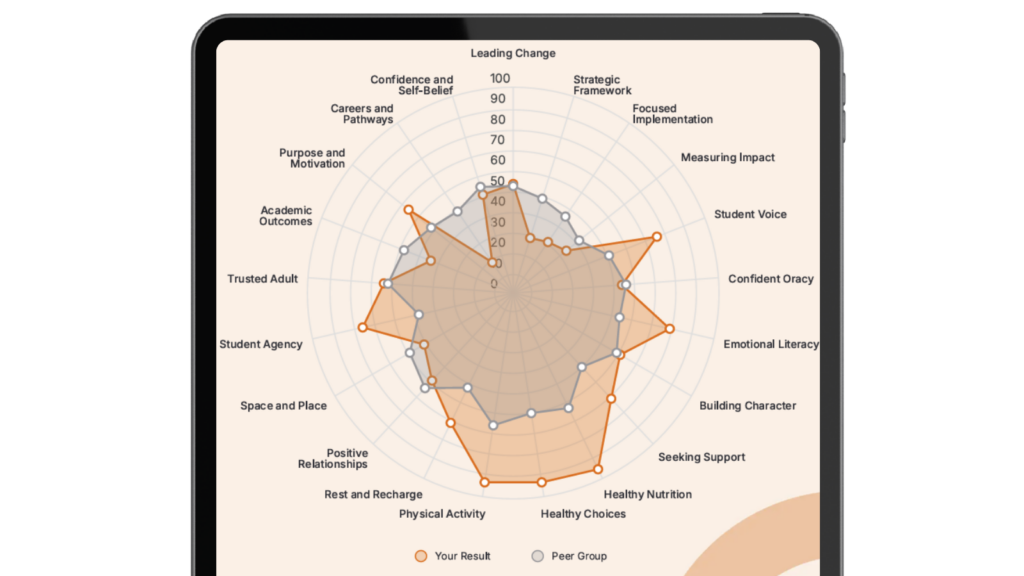
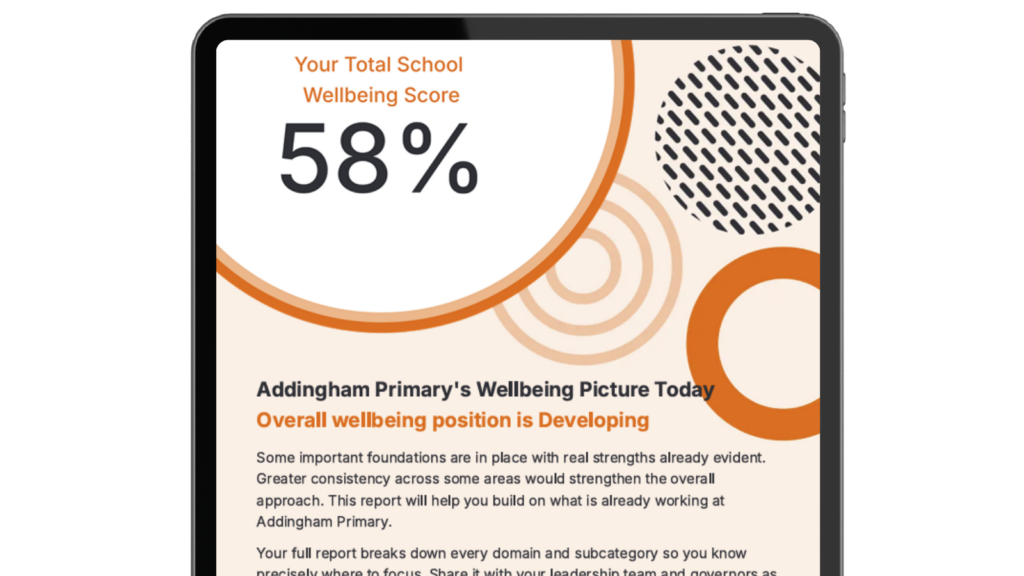
    Every school that completes it receives a personalised diagnostic report across five areas: leadership of wellbeing, mental wellbeing, physical wellbeing, belonging, and achievement and aspiration. The report is specific to your school and your context and it identifies strengths and development areas so that the work you do next is focused on what your pupils and your community actually need.

    The report is an informed starting point that lets school leaders build a wellbeing strategy with confidence, knowing their priorities are grounded in evidence rather than assumption.

    The step that many schools skip

    The data on pupil wellbeing is clear, and it’s asking something of school leaders. The response to it doesn’t have to be a long list of new initiatives or a wholesale rethink of provision that’s already working.

    It starts with knowing where you are. That’s the step that makes everything else more likely to stick. 

    One question to take away: when did your school last look across all four wellbeing domains at once, rather than responding to whichever one felt most urgent? 

    The PiXL Wellbeing Survey takes 20 minutes to complete. If your school hasn’t done it yet, there’s still time this week. Get your personalised report here

  • Why good schools still lose ground at transition

    Why good schools still lose ground at transition

    Every school has a transition process and most of them are thorough. 

    There are handover meetings. Documents that follow students from one teacher to the next. Assemblies about what to expect, sessions for students to meet their new teacher, and careful conversations between staff about which students need additional support. Schools put genuine time and effort into this. And then September arrives and for some schools, somewhere between July and October, ground that was secure in the summer starts to slip. Students who made strong progress through the year arrive in a new classroom, with a new teacher and some of what they’d consolidated falls away. It’s not inevitable. The schools that navigate transition well show that with the right information travelling with students, September can be a running start rather than a reset.  

    A study published in 2025, tracking more than 100,000 students across 200 schools, measured what happens to students at the point of transition. On average, enjoyment of school falls from around 6 in 10 students in Year 6 to fewer than 4 in 10 by Year 7. The same data suggests that engagement, enjoyment, trust, agency, safety, all dips at the point of transition and doesn’t fully recover across the secondary years.  

    The Education Endowment Foundation (EEF) identifies three consistent challenges that can affect student progress at transition: social and emotional adjustment, curriculum continuity, and the reset of relationships between students and the adults who support them. The attainment dip at Year 6 to Year 7 is often a product of all three. But curriculum continuity is worth singling out, because it’s the challenge that follows students into every stage where they move on and the adults around them are starting from scratch.  

    What gets less attention is why it persists in schools that are doing the right things. Schools with good leadership, strong teaching and genuine commitment to getting transition right still see it. Transition is genuinely complex, and the challenge doesn’t always sit where it’s easiest to see.  

    It’s not only the students you’d expect to struggle. A high-achieving learner can find transition just as difficult if the curriculum expectations in their new setting are pitched too low, or if there hasn’t been enough opportunity to reflect carefully on what they need next. That’s not a failure of intention. It’s what happens when the focus lands on the process of moving students on, rather than on what travels with them.  

    Schools have been refining transition process for years, and the commitment behind that work is genuine. The question worth sitting with is whether the process is carrying the right things, because when it does, transition becomes less of a pressure point and more of a genuine opportunity to move students forward with momentum. 

    Most transition documentation records achievement. It tells the receiving teacher what a student has covered, what level they’re working at, what interventions they’ve had. What it doesn’t always carry is a precise diagnostic picture. Where the specific gaps are. What they’ve nearly secured. What’s still shaky beneath a surface that looks fine. What the previous teacher tried, what worked and what didn’t. Without that, September becomes a month of building the picture from scratch. The support that could start in week one gets delayed until the new teacher has gathered enough of their own evidence to act. 

    Diagnose, Therapy, Test, Revisit (DTTR) gives schools a structure for making that diagnostic picture specific enough to be useful. In Reading, Mathematics and Writing, the gaps that matter most at transition are often not the ones that show up in summative data. They’re the foundational concepts a student has learned to work around rather than through. A child who has developed strategies for managing a gap in place value can look perfectly competent until Year 5 introduces column methods that depend on understanding what each digit represents. A student with shaky reading fluency can hold things together until the volume and complexity of text in the following year makes the gap impossible to hide. By then, the receiving teacher is finding out rather than following up. 

    The EEF’s Transition Toolkit asks a question that cuts to the heart of it: how is diagnostic assessment used in the new setting to identify knowledge of foundational curriculum concepts and skills? For many schools, this is still an area in development, doing it precisely and early enough is genuinely difficult. Most teachers receiving a new class in September are building that diagnostic picture from scratch, in real time, with thirty students in front of them. That work could have been done during the summer term. When it hasn’t been, it can contribute to the first half term being spent building the picture that transition could have created. The schools that excel here don’t do more. They do it earlier, and they do it with enough precision that the receiving teacher walks into September ready to act. 

    Transition isn’t only an academic event. The same 2025 study found that a third of girls and more than a quarter of boys don’t clearly say they feel safe at school by Year 9. Feelings of safety fall steadily across the secondary years. Disadvantaged students report lower levels of trust, enjoyment and belonging. Girls are more likely to feel unsafe and worried in Years 7 to 9. The EEF identifies healthy peer networks and school routines and expectations alongside curriculum continuity as the three challenges that shape whether transition succeeds or fails. A student who is anxious about friendships, or uncertain about what’s expected of them in a new classroom, is a student whose academic progress is already at risk before a single lesson has been taught. A transition plan that treats academic gaps and wellbeing as separate problems is already working with an incomplete picture. 

    Plotting students on a Horsforth Quadrant during transition planning sharpens the conversation for exactly this reason. It maps effort or attitude to learning against progress rather than attainment alone and asks a different set of questions. A student showing high effort and low progress needs something different from a student showing low effort and low progress. Their attainment data might look identical. What’s driving it won’t be. Transition conversations that start from that distinction tend to produce more useful plans. 

    Most schools don’t need a different transition process. They need the one they have to carry more precise information. To ask more specific questions and to build in enough diagnostic activity during the summer term that the receiving teacher starts September knowing what to do with each student, rather than spending the first half term working it out. 

    The schools that manage transition well aren’t the ones with the most elaborate handover procedures. They’re the ones where the conversation between current and receiving teachers is specific enough to be useful. Where the focus isn’t “how’s this student doing?” but “here’s exactly where this student is, here’s what they need next, and here’s what we already know works for them.” 

    That conversation needs to happen before the summer. By September, the opportunity to find the time to have that conversation becomes much harder. The schools that manage transition well have usually made one decision: to treat the summer term as the starting point for autumn, not the end of summer. That decision is available to every school and the tools to support it are in your members area. 

    PiXL members: Securing the Fundamentals for KS1 and KS2 is in your member area. Built specifically to support the diagnostic side of transition planning, with tools for Reading, Mathematics, GPS and character and wellbeing, as well as guidance for Writing and Oracy that can underpin handover conversations and inform the support students receive from the first week of the autumn term. Log in at pixl.org.uk to access it.