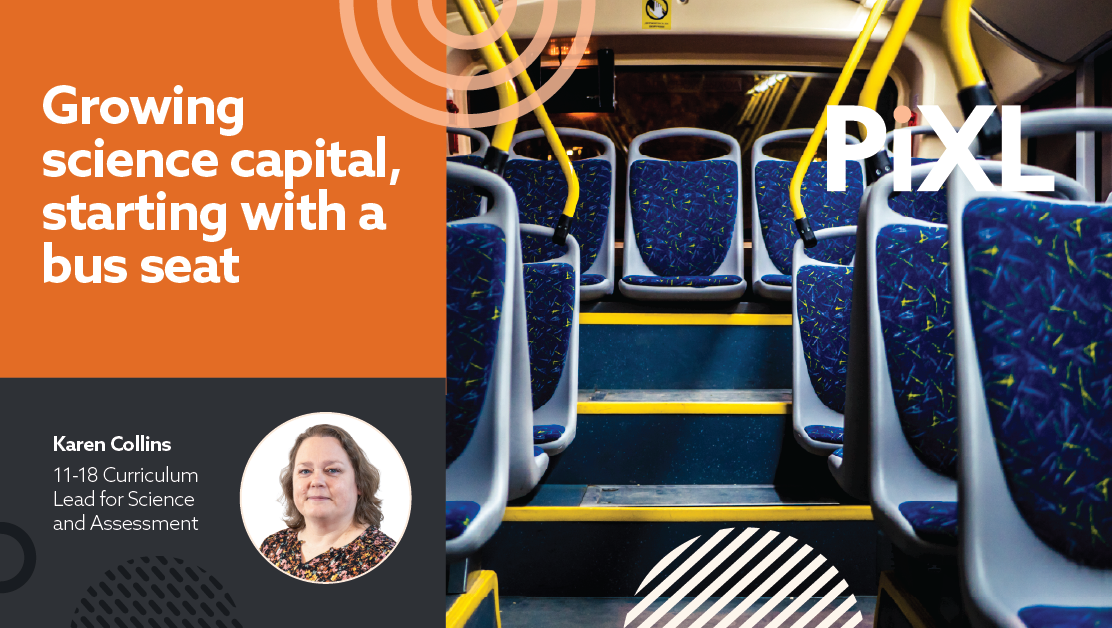
Look closely at a bus seat. The pattern, the fabric, the foam underneath. There’s more science in it than you might think.
The fabric is woven moquette, designed with a dense pile that springs back after thousands of journeys. The pattern does a job too. Busy, high-contrast designs hide wear and stains, which is materials science meeting practical economics. Underneath sits foam engineered to compress and recover, fire-tested to standards most passengers never hear about.
None of this looks like science to most children. And that gap, between the science they meet in lessons and the science woven through their everyday lives, is exactly what the idea of science capital helps us understand.
What is science capital?
Science capital describes the sum of all the science-related knowledge, attitudes, experiences and resources a person builds up through their life. It covers what they know about science, how they feel about it, who they know with an understanding of it, and how often they encounter it day to day.
The research, from the ASPIRES project led by Professor Louise Archer and colleagues at UCL, found something that matters enormously for schools: a child with higher science capital is more likely to believe that science is for them. They’re more likely to see it as something that belongs to people like them, and a world they could belong in.
The harder part of the research is that science capital isn’t evenly spread. Some children grow up surrounded by it and many don’t, and left alone, that gap tends to reproduce itself. Which is exactly why what schools do here matters so much.
What schools are already doing
The encouraging part is that schools can grow science capital, and many already are. Trips to science centres and museums. Field work. Science and environment clubs. CREST Awards through the British Science Association, which give pupils ownership of real investigations.
But some of the most powerful work costs nothing. It starts with showing children that science is all around them, well beyond the obviously scientific objects like a phone or a laptop.
Pick any object. The curry sauce from the local takeaway. A cup of coffee. A piece of gym equipment. That bus seat. Then ask one question: what’s the science behind this?
The local angle matters too. When the object comes from a business pupils walk past every day, the question quietly becomes a careers conversation. A textile technologist chose that seat fabric. The foam was specified by a materials engineer and signed off by a safety tester before it carried a single passenger. Jobs like these exist here, in this town.
A challenge for this week
Choose one everyday object with your class, ideally something from your local area, and spend ten minutes unpicking the science behind it. If you want questions you can lift straight into the lesson:
What’s it made of? Why that material and not something else? How would you test whether it does its job? Who decided it was safe, and how would they know? What would you change about it?
Then ask pupils to bring in their own.
And when your class has picked its object, share it with us. Tag PiXL and use the Science Week hashtag, because half the fun is seeing what other schools choose, and we will be resharing our favourites all week.
If you want to go deeper, the Science Centres introduction to science capital is an excellent starting point, and PiXL members can find disciplinary literacy and numeracy activities for international days in the members’ area.
Start with one object on Monday morning and see where your pupils take it.