
Last week’s blog post looked at why pupils’ wellbeing dips so sharply at transition and what schools can do about it. But transition is one moment in a much bigger picture, and many schools don’t yet have a clear view of what that picture looks like.
Wellbeing is on every school’s agenda. It’s in the strategy documents, in the CPD sessions and in the conversations that happen long before an inspector arrives. School leaders care deeply about the young people in their schools and work hard to show it.
But caring about wellbeing and knowing where your school stands on it are two different things. And for many schools, it’s the second part that’s harder to answer honestly.
There’s a difference between a school that has wellbeing provision and a school that has a clear, evidence-based picture of how that provision is landing. That difference matters more now than it ever has.
Wellbeing isn’t one thing
Wellbeing isn’t a single dial that turns up or down. It’s a collection of interconnected dimensions, each of which affects the others in ways that are easy to miss when you’re focused on the most visible pressure point.
At PiXL, we think about pupil wellbeing across four domains: mental wellbeing, physical wellbeing, belonging, and achievement and aspiration. Each matters in its own right, but it is often the connections between them that give schools the clearest insight.
A pupil who’s struggling to feel like they belong will often show it in their mental wellbeing, and that knock to their sense of self follows them into the classroom. Poor physical health directly affects a young person’s capacity to learn, whether that shows up as inadequate sleep, limited activity or inconsistent nutrition. And aspiration without the support structures to reach it leaves pupils in a place that looks like disengagement from the outside but is something more complicated underneath.
Whole school approaches that work, do so because they hold all four domains in view at once. That requires a framework. And a framework has to start with knowing where you are.
What the evidence is saying
The evidence on pupil wellbeing right now is asking school leaders to take it seriously.
Edurio’s survey of 184,000 pupils from Year 4 to Year 13 points to a sustained decline in pupil wellbeing over time. Children report lower levels of happiness at school and higher levels of stress. The number of pupils who say they have a trusted adult in school is also falling, which matters deeply given the role trusted relationships can play in helping children feel safe, known and supported.
The Parentkind National Parent Survey 2025 found that one in five children are unhappy at school. That’s two million young people. Children from low-income households are twice as likely to be bullied as those from higher-income families, and social isolation is cited as the cause of unhappiness by 35% of unhappy primary pupils. 177,000 children in primary schools alone who feel they don’t have a place where they fit. That number should stop us in our tracks.
The Children’s Society’s Good Childhood Report 2025 shows that girls continue to report lower wellbeing than boys across a range of areas. This is an important pattern for schools to understand, particularly when considering whether their wellbeing provision is reaching different groups of pupils in the right ways.
The Education Endowment Foundation’s research on social and emotional learning shows that evidence-based SEL interventions add three months of additional academic progress in a year. Wellbeing and school improvement aren’t separate agendas. They never were.
Ofsted’s current inspection framework includes personal development and wellbeing as an evaluation area, which makes it even more important that schools can explain their approach as well as their strengths and areas for development clearly.
1 in 5 children are unhappy at school. Over time, the picture on pupil wellbeing has become increasingly concerning.
Knowing where you stand
Most schools have wellbeing provision: pastoral systems, PSHE programmes, and staff trained in mental health first aid. Some have been building this carefully for years and it’s making a real difference.
The research on what makes whole-school wellbeing approaches work is consistent on one point: they start with honest self-assessment. Understanding where you are is what makes everything that follows purposeful rather than well-intentioned but scattered.
When you know where your school stands across all four domains, you can make decisions about where to put your weight. You can see which areas are already strong and which need focused attention. And you can connect your wellbeing strategy to your wider school improvement priorities, rather than running it alongside them as a separate concern.
Schools that have that picture are in a stronger position to make purposeful decisions for pupils, staff and the wider school community, with a clearer understanding of what’s working and where further support is needed.
There’s a fifth dimension too, and it’s the one most directly in the hands of the person reading this: the leadership of wellbeing itself. How wellbeing is prioritised, talked about and embedded in a school’s daily culture shapes what’s possible across all four domains. It goes beyond having a wellbeing lead or a strategy document. It’s whether the people who set the tone for a school treat wellbeing as central to how they lead. Most school leaders would say they do. Having the evidence to back that up is a different thing.
A clearer picture
The PiXL Wellbeing Survey gives schools that starting point.
Every school that completes it receives a personalised diagnostic report across five areas: leadership of wellbeing, mental wellbeing, physical wellbeing, belonging, and achievement and aspiration. The report is specific to your school and your context and it identifies strengths and development areas so that the work you do next is focused on what your pupils and your community actually need.
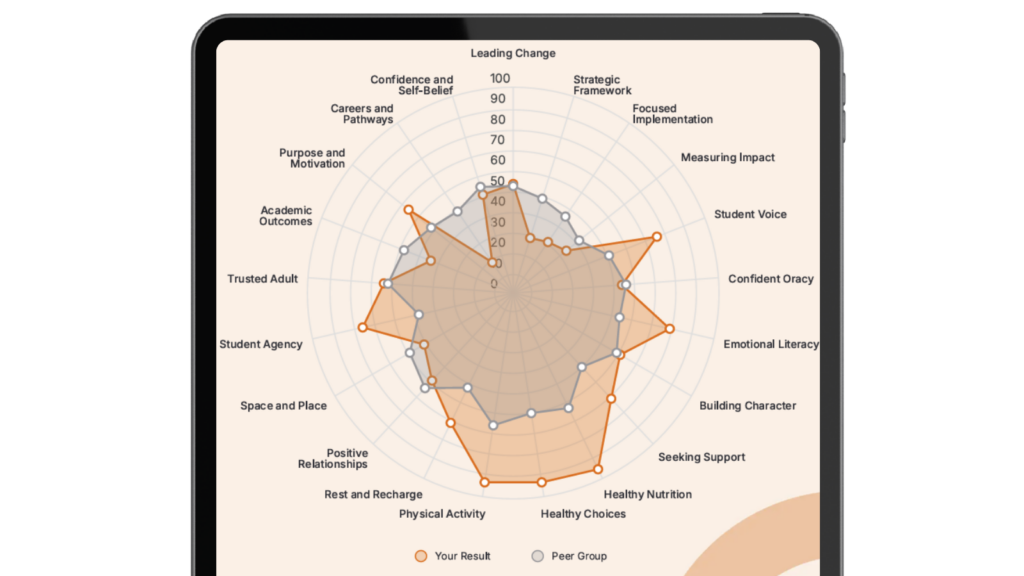
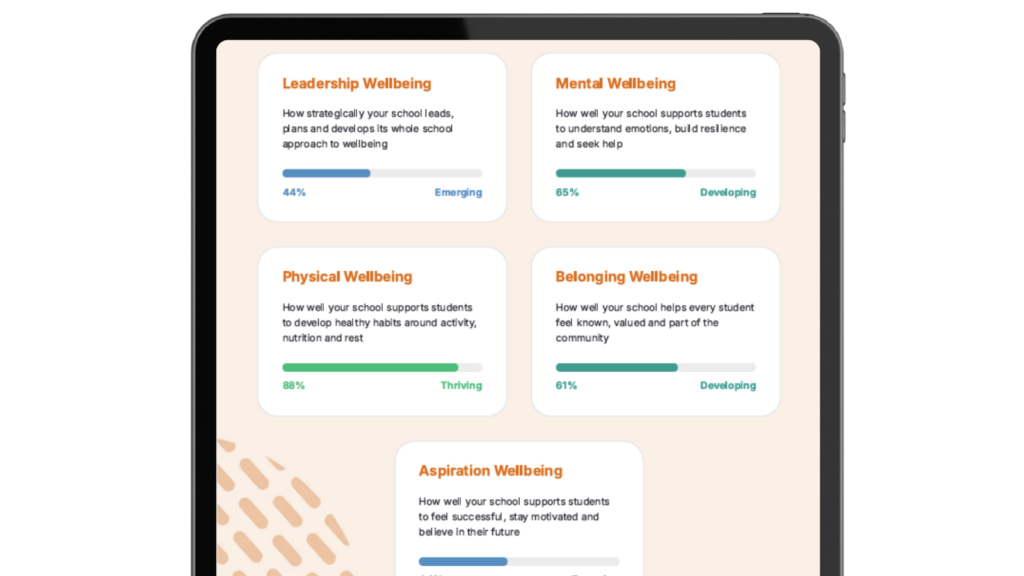
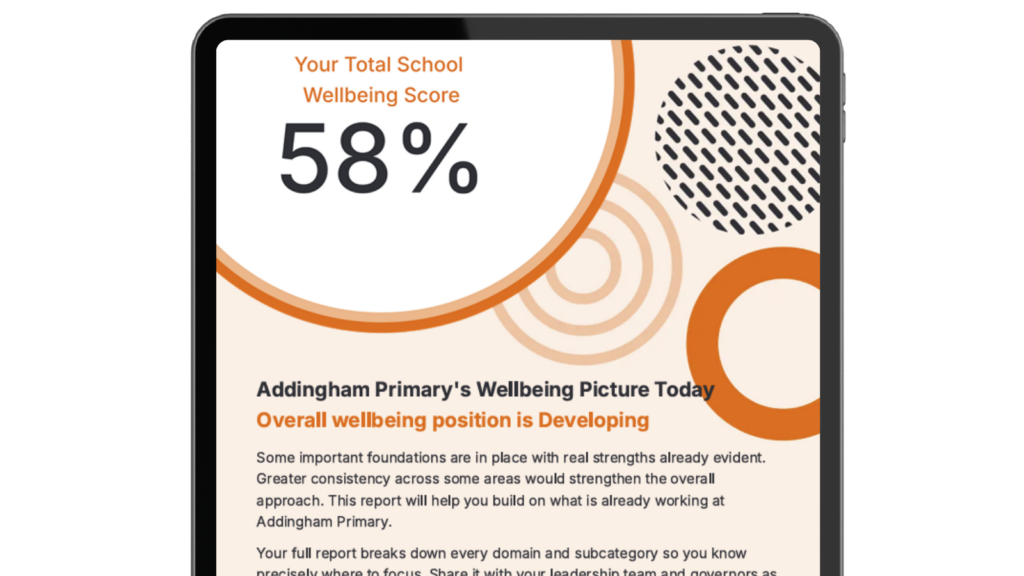
The report is an informed starting point that lets school leaders build a wellbeing strategy with confidence, knowing their priorities are grounded in evidence rather than assumption.
The step that many schools skip
The data on pupil wellbeing is clear, and it’s asking something of school leaders. The response to it doesn’t have to be a long list of new initiatives or a wholesale rethink of provision that’s already working.
It starts with knowing where you are. That’s the step that makes everything else more likely to stick.
One question to take away: when did your school last look across all four wellbeing domains at once, rather than responding to whichever one felt most urgent?
The PiXL Wellbeing Survey takes 20 minutes to complete. If your school hasn’t done it yet, there’s still time this week. Get your personalised report here